
You have asked the school to evaluate your child. Maybe more than once. And the response has been some version of “let’s give it more time,” “we want to try some interventions first,” or “your child is doing well enough that we don’t think an evaluation is warranted right now.” Meanwhile, you are watching your child struggle, fall further behind, and come home more frustrated every week. The school’s patience feels a lot less like good judgment and more like a delay that costs your child irreplaceable time.
If this sounds familiar, I want to be direct with you: schools cannot legally delay a special education evaluation indefinitely. The moment you submit a written evaluation request, Arizona law puts a timeline on the district. Here is what the law says, what the school may be doing wrong, and exactly how to push back in a way that gets results.

Your Right to Request a Special Education Evaluation
Under the Individuals with Disabilities Education Act (IDEA), any parent can request a full and individual evaluation to determine whether their child has a disability and needs special education services. This right is not conditional on teacher agreement, prior intervention programs, or the school’s professional opinion about whether your child needs help.
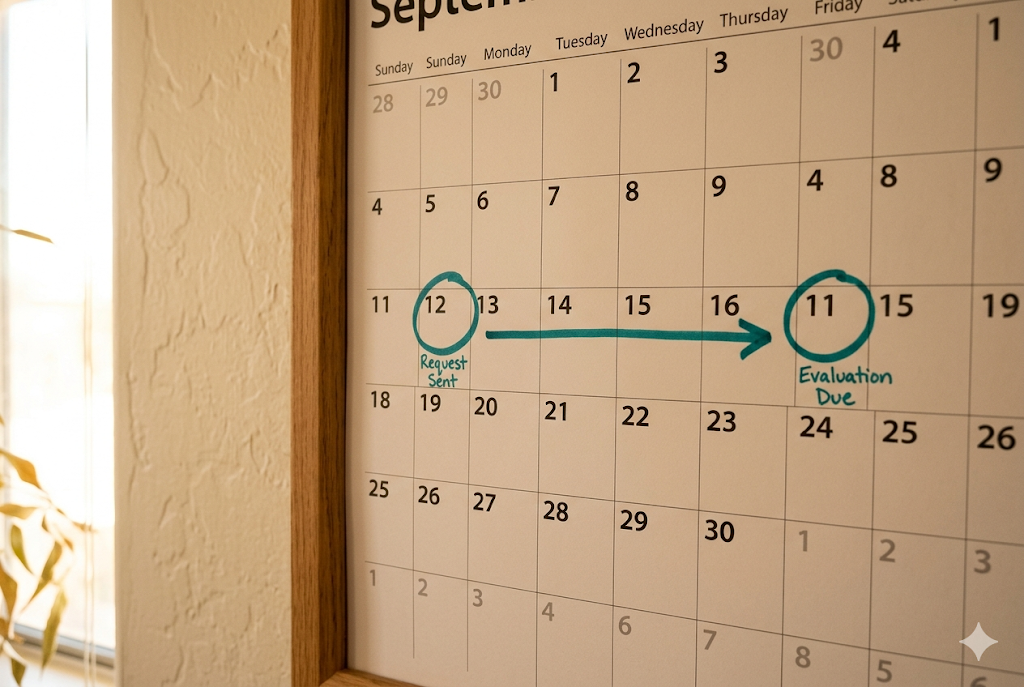
Arizona implements this federal right through state law and Arizona Department of Education guidance. When you submit a written evaluation request, the district has 60 days to complete the evaluation, with some limited exceptions for student absences and mutually agreed-upon extensions.
The 60-day clock does not start until the district receives your written permission to evaluate. Verbal requests, parent-teacher conference conversations, and emails asking for a meeting to discuss evaluation do not start the clock. Only a written evaluation request to the district, clearly identifying that you are requesting a special education evaluation under IDEA, starts the timeline.
What “Wait and See” Actually Means Legally
Schools often use the language of Response to Intervention (RTI) or Multi-Tiered System of Supports (MTSS) to justify delays. These are legitimate frameworks for providing early academic support to struggling students, but they cannot be used to indefinitely postpone a parent-requested evaluation.
The U.S. Department of Education has made clear that a district may not use RTI strategies to delay evaluating a child for special education when a parent requests one. The Office of Special Education Programs (OSEP) has issued guidance stating that RTI is not a substitute for a full evaluation and cannot be used as a procedural gatekeeping mechanism that delays parental evaluation requests.
If a school tells you they want to “try interventions first” in response to your evaluation request, that is not a legally valid reason to postpone the evaluation. You can proceed with your written request while interventions continue. Both can happen simultaneously.
How to Submit an Evaluation Request That Starts the Clock
Write it down. Do not rely on phone calls, verbal requests at IEP meetings, or even emails that only ask for a meeting to discuss evaluation. Your request must be clear and direct: you are requesting a full and individual evaluation of your child under IDEA to determine whether they have a disability and require special education and related services.
Send the request in writing to the special education director at your district, not only to the classroom teacher or case manager. Copy the principal. Send via email so you have a timestamped record. If you want a belt-and-suspenders approach, send the email and follow up with a physical letter sent via certified mail. The email timestamp is your evidence that the clock has started.
Your request should include your child’s name, grade, and school. You do not need to diagnose your child or specify what kind of evaluation you want. You do not need to have evaluation-level documentation already in hand. A parent’s written request based on their concerns about their child is sufficient to trigger the evaluation process.
What Happens If the School Still Refuses
A district cannot legally refuse a parent evaluation request outright unless they provide you with Prior Written Notice (PWN) explaining why they are declining to evaluate and informing you of your dispute resolution rights. If you receive a PWN that declines evaluation, read it carefully. It should explain the district’s reasoning with specific evidence, not simply state that they don’t think evaluation is necessary.
A vague or unsupported denial is something I see regularly in Phoenix-area schools, and it is something families can and do successfully challenge. Your options include:
- Requesting mediation through the Arizona Department of Education at no cost to you
- Filing a state complaint with ADE’s Exceptional Student Services division
- Requesting a due process hearing
- Requesting an independent educational evaluation (IEE) if the district has conducted an evaluation you disagree with
Filing a state complaint is often the fastest route when the issue is procedural, such as a missed evaluation timeline or an improper denial. Complaints must be resolved within 60 days and can result in corrective action orders requiring the district to conduct the evaluation.
Red Flags That the Delay Is Intentional
Not every delay is intentional. Case managers are overloaded. Evaluators are in short supply. Arizona has a documented shortage of special education staff. But some delays are strategic, and recognizing the pattern helps you respond appropriately.
- The school repeatedly schedules and then cancels or postpones meetings about evaluation
- You receive verbal assurances but nothing in writing, ever
- The school asks you to try interventions for “just one more semester” multiple times in a row
- You are told your child “doesn’t really fit” the evaluation criteria without any formal review
- The response to your written request is a phone call rather than written documentation
- You are encouraged to have private testing done instead of district evaluation
If two or more of these are happening, the pattern of delay is worth taking seriously and documenting.
The Cost of Waiting
I work with families who waited a year or more before pushing back on evaluation delays, often because they trusted the school’s assurances or were afraid of damaging the relationship. I understand both of those feelings. But the research on early identification of learning disabilities, language delays, and behavioral challenges consistently shows that earlier intervention produces better outcomes.
Every semester of delay is a semester your child is not receiving the services they may be entitled to. The school’s reluctance to evaluate is not a neutral position. It has consequences for your child’s academic trajectory, and those consequences are not distributed evenly between the school and your family.
The end of the school year is actually a good time to file a formal written request if you have not already done so. It creates a record before summer, and a 60-day timeline that starts in May or June means evaluation should be completed by the time school resumes in the fall.
Frequently Asked Questions About Evaluation Delays
Does Arizona require a specific format for a written evaluation request?
Can the school require me to complete a referral process before they consider my request?
What if the school evaluates my child and says they don't qualify?
What if the school evaluated my child but I think they evaluated the wrong things?
How long does the 60-day evaluation timeline apply during summer?
What is the difference between a referral and a parent evaluation request?
You Have the Right to an Answer
If you have been asking the school to evaluate your child and getting delays, excuses, or gentle redirection, you deserve a definitive response in writing. The law gives you that right. Using it is not confrontational. It is exactly what the parent rights provisions of IDEA were designed for.
If you want support navigating this, I am here. I help Phoenix and Scottsdale families move through evaluation disputes regularly, and I know how to push back on district delays in a way that gets your child evaluated without destroying the relationship you will need to work with the school going forward.
Call or text 480.973.3553 or reach me through the contact page. I respond to crisis situations quickly, and evaluation delays are a crisis I take seriously.