
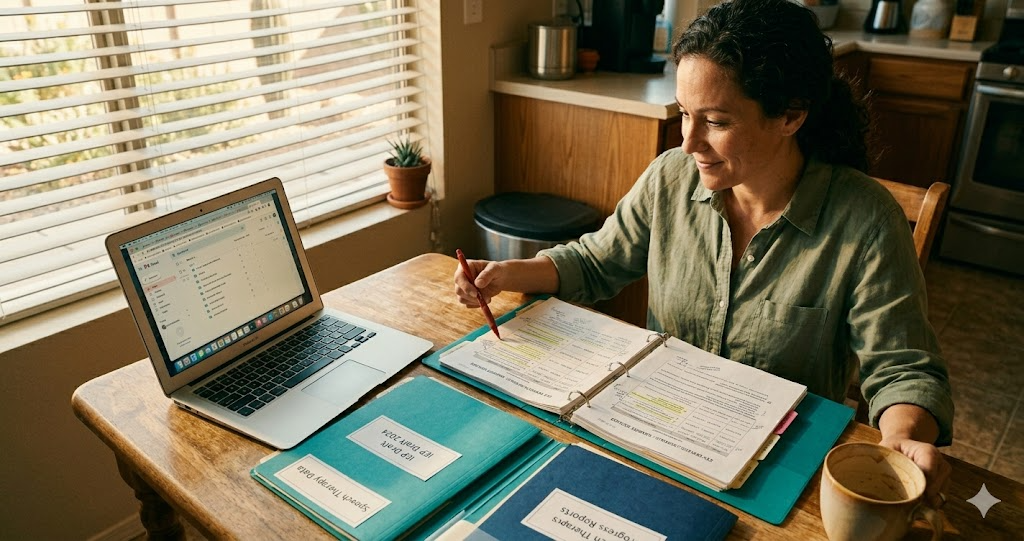
Every summer, I hear from parents who realize they no longer have documents they desperately need. The case manager retired. The school changed software systems. The files weren’t transferred when their child changed teachers. And now they are walking into a new school year without the records that would have protected their child. That fear of losing ground, of starting over without proof of what was promised, is one of the most unnecessary sources of stress in this process.
You can prevent it. This checklist covers every IEP-related document you should have in your possession before Arizona schools close for summer. It takes one afternoon to pull together, and it can save you months of back-and-forth in the fall.
Why End-of-Year Document Collection Matters
The end of the school year is a natural disruption point for special education records. Case managers transition. Classrooms change. Some districts archive or migrate records over the summer. Under the Family Educational Rights and Privacy Act (FERPA) and IDEA, you have the legal right to access your child’s educational records at any time, but exercising that right takes longer when you request files in September than it does when you request them before June.
Having your own complete file also means you are not dependent on the district’s records when discrepancies arise. If the school’s record says a service was delivered and you have session logs that say otherwise, your documentation matters. If the IEP says one thing and the school’s implementation memo says another, your copy of the IEP is the evidence.

The IEP Document Checklist
Work through this list section by section. Request anything you do not already have in writing, via email, to your child’s case manager with the special education director copied.
Current IEP Document
- The full, most recent IEP with all signature pages
- All addenda and IEP amendments made during the school year
- Prior Written Notices (PWN) received this year
- Any IEP meeting notes provided by the district
- Your own notes from IEP meetings
Evaluation and Assessment Records
- The most recent full and individual evaluation (FIE) or triennial evaluation report
- Any independent educational evaluations (IEEs) conducted this year or previously
- Eligibility determination documents
- Progress monitoring data used to support IEP goals
- Teacher observation notes included in any evaluation
Service Delivery Documentation
- Session logs for each related service (speech therapy, OT, PT, ABA, counseling)
- Attendance records for specialized instruction
- Service delivery confirmation for any ESY (Extended School Year) services this year
- Documentation of any services that were missed and how they were made up (or not)
Goal Progress Records
- Progress reports issued on each IEP goal during the school year
- Data collection sheets for individual goals (if your district provides these)
- End-of-year progress report, including whether each goal was met, progressing, or not met
Behavior and Support Records
- Functional Behavior Assessment (FBA), if one was conducted
- Behavior Intervention Plan (BIP), if one is in the IEP
- Incident reports related to behavioral situations (especially any that resulted in discipline, removal, or suspension)
- Documentation of any restraint or seclusion incidents
School Communications
- All emails between you and any school staff regarding IEP services, meetings, or concerns
- Letters from the district regarding eligibility, services, or dispute resolution
- Any written responses to your requests or concerns
- Consent forms you signed, including evaluation consent and placement consent
Related Assessments and Reports
- Speech-language evaluation reports
- Occupational therapy evaluation reports
- Psychological evaluation reports
- Medical documentation submitted to the school, if any
- Any outside provider reports shared with the school team

How to Organize What You Collect
You do not need a complicated system. A physical binder with tabbed sections works well. So does a single folder on your computer with subfolders. What matters is that you can find what you need quickly when you are sitting in an IEP meeting under pressure.
My recommended structure: one section per category above, with documents in reverse chronological order (most recent on top). Keep digital backups of everything in a cloud folder. This is not about paranoia. It is about knowing that when something goes wrong, you have what you need without scrambling.
Date every document when you receive it, even if the document itself isn’t dated. A simple note like “received via email from case manager, May 8, 2026” takes ten seconds and matters enormously if you ever need to establish a timeline.
How to Request Documents You Don’t Have
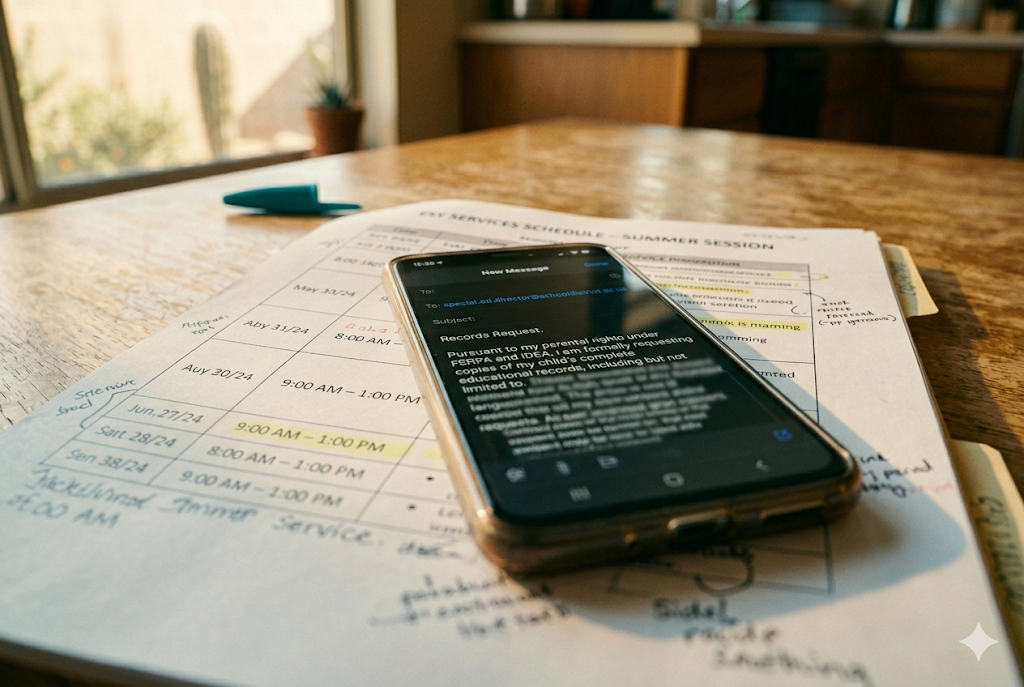
Send a written request to your child’s case manager with the special education director copied. Your email should be simple and direct: state that you are requesting a complete copy of your child’s educational records, including the categories listed above, and ask for them by a specific date (10 to 15 school days is reasonable). Under FERPA, the district must comply within 45 days, but most Arizona districts will respond faster with a reasonable, specific request.
If you are not sure whether a specific document exists, ask. “Please confirm whether a Functional Behavior Assessment was conducted for my child and if so, please provide a copy” is a perfectly appropriate request. You do not need to know in advance what records exist in order to request them.
Under IDEA, school districts may charge a reasonable fee for copying records, but cannot charge in a way that prevents parents from exercising their rights to access records. If cost is a concern, note it in your request and ask about any waiver policy.
What to Do If the School Says Records Aren’t Available
Session logs, evaluation reports, and IEP amendments are not optional records. They must be maintained by the district. If a school tells you that records don’t exist or can’t be provided, put your response in writing immediately. State that you understand records must be maintained under IDEA and FERPA, and that you are requesting confirmation in writing of which records exist and which do not.
Incomplete or missing records are themselves a problem worth documenting. If service logs don’t exist for services that should have been delivered, that is not a filing oversight. That is evidence that services may not have been provided as required.
Frequently Asked Questions About IEP Documentation
How long should I keep IEP documents?
Can the school destroy my child's IEP records?
What if I didn't receive progress reports on IEP goals this year?
Do I need the session logs for related services, or just the IEP?
Can I take notes at an IEP meeting and have them included in the record?
What should I do with all of this documentation over the summer?
A Few Hours Now Protects Your Child All Year
The parents who walk into fall IEP meetings prepared are the ones who get the best outcomes. Not because they are more aggressive or louder, but because they know exactly what happened last year and have the documentation to prove it. That knowledge changes the conversation.
If you are unsure which records you should have, what you are missing, or what a document you already have actually means for your child’s case, I am glad to help. A records review consultation can save you significant time and prevent you from arriving at the fall IEP meeting without the foundation you need.
ESY violations are one of the most time-sensitive situations in special education advocacy because every missed day of services is a day of potential regression that cannot be fully recovered. If your child’s school is not following the ESY plan, the most important thing you can do right now is start documenting and put your concerns in writing today.
If you would like support navigating this situation, I am here. I have worked with Phoenix and Scottsdale families through ESY disputes, state complaints, and compensatory services negotiations, and I know how to move school districts toward compliance when informal resolution is not working.
Reach me at 480.973.3553 or through the contact page. I respond to email inquiries within one business day and can often answer quick records questions the same day.