The anger comes through even in the emails I get from parents about this. “The school said my child’s IEP was no longer needed and offered a 504 plan instead. They made it sound like a step forward. Now I realize we lost services.” Or the opposite: “My child has a 504 but it’s not enough. The school says this is all they qualify for.” The IEP versus 504 question is the most common thing parents ask me, and the most common thing schools get wrong, sometimes innocently, sometimes not.
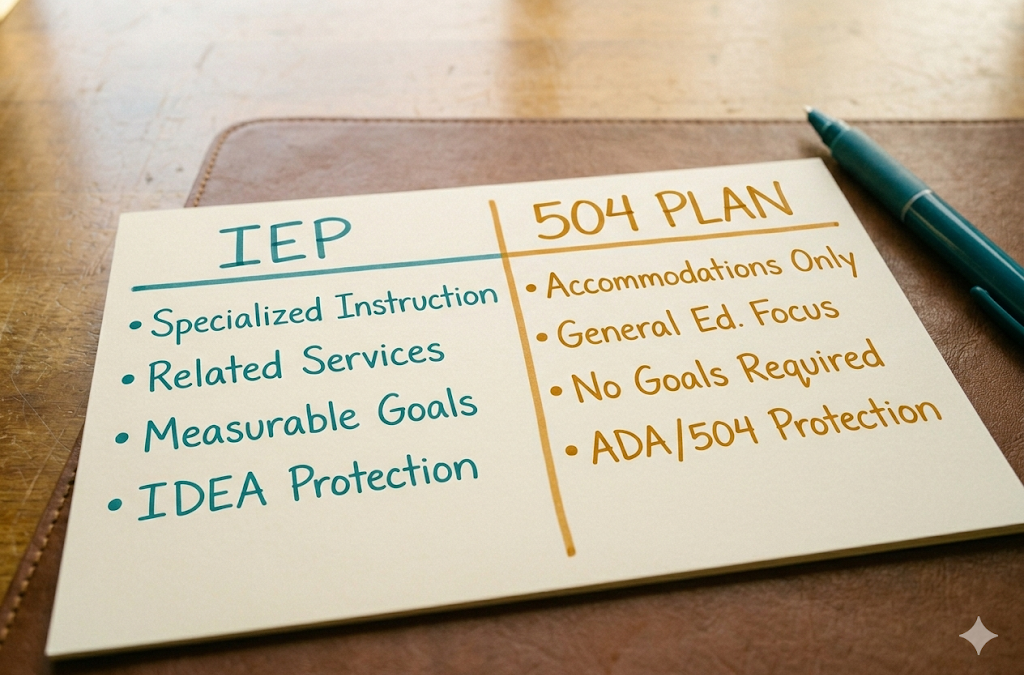
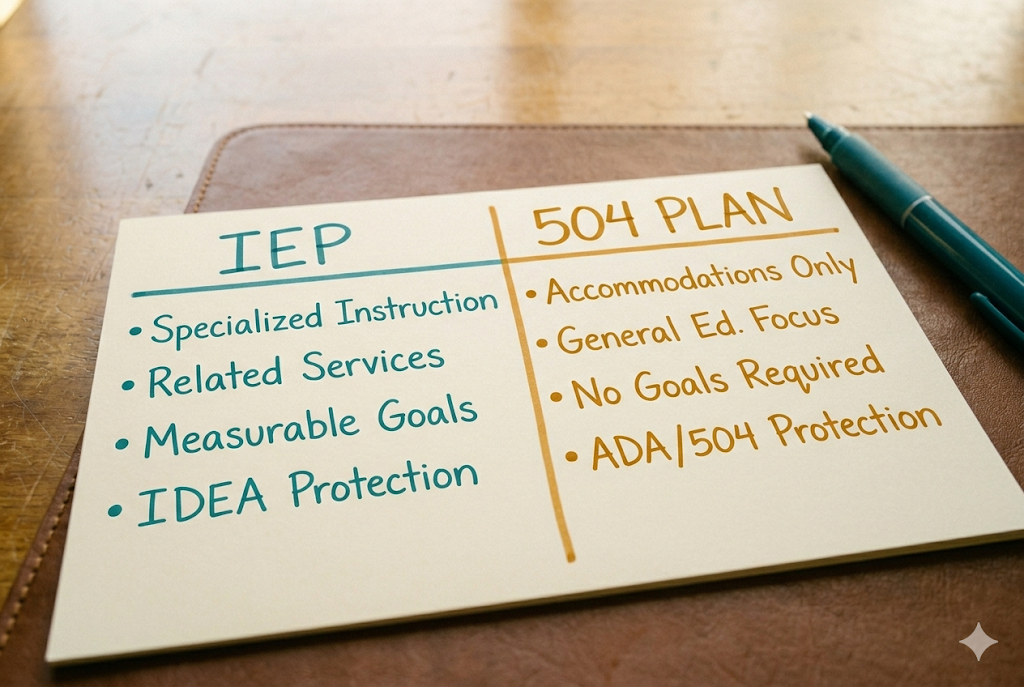
Here is the clear version, without jargon. An IEP is a special education document governed by IDEA that provides specialized instruction and related services. A 504 plan is a civil rights accommodation plan governed by Section 504 of the Rehabilitation Act that removes barriers but does not provide specialized instruction. Both matter. Neither is inherently better. But the difference between them determines what your child actually receives, and confusing the two, or allowing a school to switch your child from one to the other without cause, has real consequences.
What an IEP Actually Provides
An Individualized Education Program is a legally binding document created under IDEA. To qualify, a student must have one of the 13 categories of disability defined by IDEA, and that disability must adversely affect educational performance in a way that requires specially designed instruction.
An IEP provides:
- Specially designed instruction, meaning curriculum, methodology, and delivery modified to meet the student’s unique needs
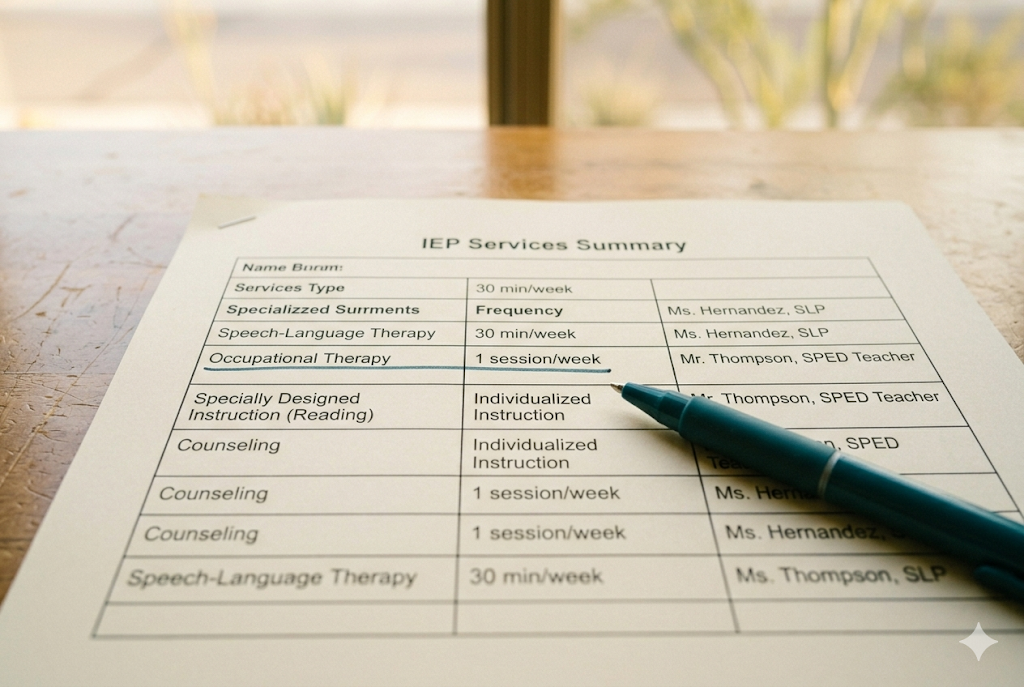
- Related services such as speech therapy, occupational therapy, physical therapy, ABA, counseling, and assistive technology
- Measurable annual goals specific to the student
- Extended School Year services when needed
- Specific accommodations and modifications to the regular curriculum
- Procedural protections including the right to dispute services through mediation and due process
- A team of qualified professionals accountable for implementing each service
The key phrase is “specially designed instruction.” An IEP changes how, where, and what your child is taught. It does not just remove obstacles. It provides active, individualized support delivered by qualified service providers.

What a 504 Plan Actually Provides
A 504 plan is a civil rights accommodation plan under Section 504 of the Rehabilitation Act and the Americans with Disabilities Act. Eligibility is broader than IDEA: any student with a physical or mental impairment that substantially limits one or more major life activities may qualify. This includes many students who do not qualify for IDEA’s 13 eligibility categories.
A 504 plan provides:
- Accommodations that remove barriers to accessing the general curriculum (extended time on tests, preferential seating, use of assistive technology, modified homework format, etc.)
- Modifications to the educational environment without changing the curriculum itself
- Access to the same curriculum as non-disabled peers, without the curriculum being altered
A 504 does not provide specially designed instruction, related services such as speech therapy or occupational therapy, or measurable annual goals. It does not carry the same legal procedural protections as an IEP. And critically, it does not carry the same accountability structure. Implementation of a 504 is far less enforceable than implementation of an IEP.

When the Switch from IEP to 504 Makes Legitimate Sense
There are real situations where moving from an IEP to a 504 is appropriate and genuinely serves the student. Understanding when this transition is legitimate helps you evaluate when it is not.
If a student has made such significant progress that they no longer require specially designed instruction to access the curriculum, but still have a disability that requires accommodations, a 504 may be a more appropriate fit than an IEP. This happens most often with students who have responded well to early interventions, have developed compensatory strategies, or whose primary remaining need is accommodation rather than specialized instruction.
If a student is transitioning to post-secondary education where IDEA protections do not apply, understanding how to function with 504-style accommodations is practical preparation, though this does not mean the transition to a 504 should happen prematurely during high school.
The test is always the same: does your child still need specially designed instruction, related services, or a structured accountability framework to make meaningful educational progress? If the answer is yes, an IEP is likely still appropriate regardless of academic improvement.

When Schools Push 504s in the Wrong Direction
This is the part of the conversation that frustrates me most, because it happens regularly and the families who experience it often don’t realize what they’ve lost until months later.
Schools have financial and administrative reasons to prefer 504 plans over IEPs. IEPs require evaluation time, qualified service providers, IEP meetings with multiple team members, documented goal progress, and procedural compliance. 504 plans require far less of all of those things. The school finance calculus is not neutral, and it influences decisions in ways families rarely see.
Here are the patterns that signal a school is pushing a 504 for the wrong reasons.
- A child with demonstrated ongoing needs is exited from an IEP and offered a 504 without a formal re-evaluation showing that specialized instruction is no longer needed
- A school offers a 504 in response to a parent evaluation request, suggesting that the child “might not need an IEP” without conducting the evaluation to find out
- A child’s IEP services are discontinued when their academic grades improve, without assessing whether the grades reflect genuine independent mastery or accommodation-dependent performance
- Parents are told a 504 is “easier” or “less stigmatizing” without a full explanation of what services will be lost
- A student with documented related service needs, such as speech therapy or occupational therapy, is placed on a 504 that provides none of those services
If any of these have happened to your child, the decision is worth revisiting.
How to Move from a 504 to an IEP
If your child is on a 504 and you believe they need an IEP, the process is a written evaluation request. Submit a written request for a full and individual evaluation under IDEA to the district special education director. State that you believe your child may have a disability that adversely affects educational performance in a way that requires specially designed instruction, and that you are requesting a full evaluation to determine eligibility for special education services.
A 504 does not block IDEA eligibility review. Having a 504 does not mean your child has been evaluated and found ineligible for an IEP. These are different processes under different laws. A school cannot refuse your IDEA evaluation request on the grounds that the child already has a 504.
The evaluation process, if the district agrees to proceed, must be completed within 60 days of your written request in Arizona. If the district declines to evaluate, they must provide Prior Written Notice explaining their reasoning, and you have dispute resolution rights to challenge that decision.
How to Protect an IEP That Is Being Removed
If the school is proposing to exit your child from an IEP and move them to a 504, they are required to provide Prior Written Notice before making that change. The notice must explain the proposed action, the district’s reasoning, the data supporting the decision, and your rights to dispute it.
You can decline to consent to the change. If the district believes your child is no longer eligible for special education, they may pursue the eligibility determination through the IEP process. But they cannot unilaterally exit your child without your input, and you are not required to accept an exit decision you disagree with without pursuing dispute resolution.
If you receive Prior Written Notice proposing to exit your child from special education, do not sign anything without understanding exactly what services your child will lose and what the district’s data shows. Request the data. Review the evaluation. And if something doesn’t add up, get a second opinion before you consent.
Frequently Asked Questions About IEP vs. 504 Plan
Can my child have both an IEP and a 504 plan at the same time?
My child has ADHD. Which plan do they need?
Does my child lose their IEP when they change schools within Arizona?
What is the difference in legal enforcement between an IEP and a 504?
Can a school remove my child's IEP without a formal evaluation?
My child's 504 accommodations are not being followed. What can I do?
You Deserve a Plan That Actually Works
The IEP versus 504 question is not academic. It is the question of what your child actually receives when they sit down in a classroom. An IEP that has been improperly exited costs your child real services. A 504 offered in place of an IEP evaluation costs your child the right to a genuine assessment of their needs.
If you are unsure whether your child is in the right plan, or if you believe the school has switched or is trying to switch your child’s plan for the wrong reasons, I am glad to talk through your situation. I work with Phoenix and Scottsdale families on IEP versus 504 questions regularly, and I can help you figure out whether the current arrangement is actually serving your child.
Reach me at 480.973.3553 or through the contact page. There is no harm in getting a second opinion before you make a decision that will affect your child’s services for the next year.