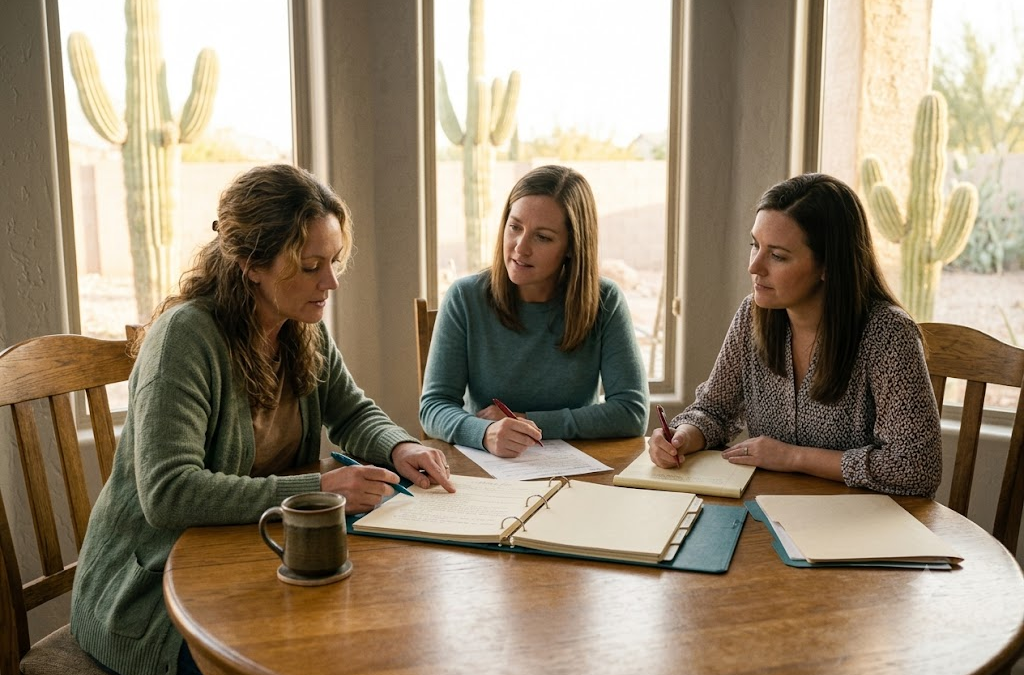
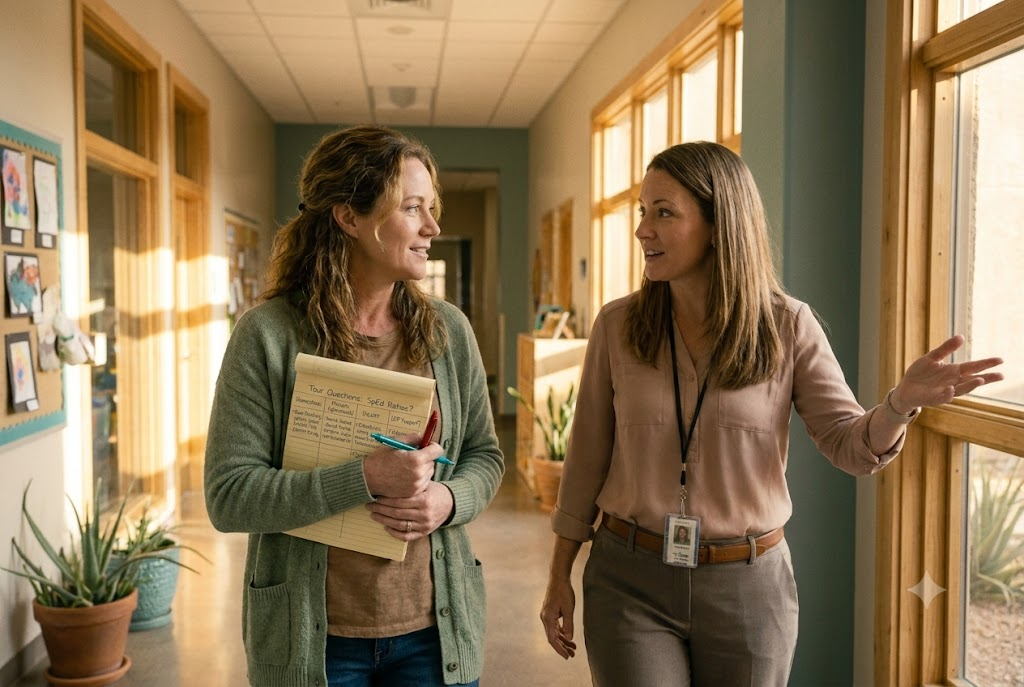
 Choosing a school can feel overwhelming, especially when every option promises to be the right fit. The best place to start is with your child’s needs, not the school’s reputation or marketing.
Ask one question first: Can this school provide the services and supports my child needs to make meaningful progress? Everything else comes after that.
The answer depends in part on the type of school you choose. Public school districts and charter schools must implement your child’s IEP and provide a free appropriate public education (FAPE). Private schools generally do not have those same obligations. If you homeschool, you become responsible for providing your child’s education. Arizona’s Empowerment Scholarship Account (ESA) program can help pay for private school or homeschool expenses for eligible students with disabilities, but it also changes important special education rights and protections.
No school is the right choice simply because it is public, charter, private, or homeschool. The right choice is the one that can meet your child’s unique needs while providing the level of support, accountability, and educational opportunity your family is looking for.
I work with forward-thinking Phoenix and Scottsdale families who want to choose well rather than react later. This guide lays out each option honestly, including the tradeoffs that are easy to miss until it is too late to undo them.
Start With Your Child’s Needs, Not the School’s Reputation
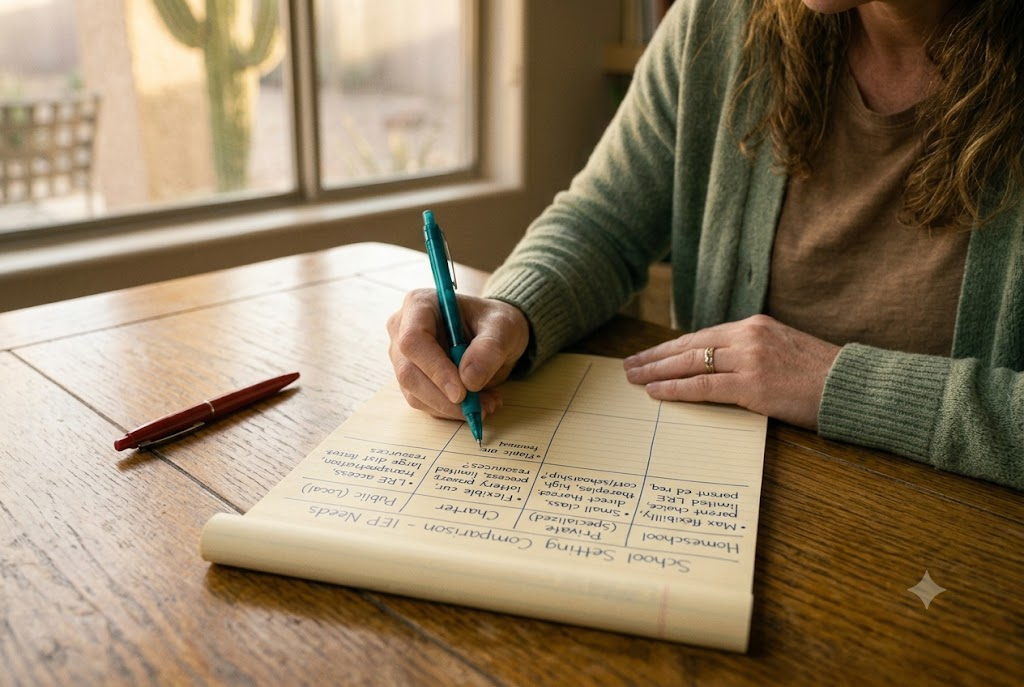
The most common mistake I see is choosing a school for its name, its test scores, or its campus, then discovering it cannot deliver what the IEP requires. A beautiful school that cannot provide your child’s reading intervention is the wrong school.
Before you compare options, get clear on what your child actually needs day to day. What services are in the IEP? What accommodations are non-negotiable? What environment helps your child regulate and learn? Hold every option up against that list. My summer IEP planning checklist is a useful starting point for getting that picture organized.
Public District Schools: The Full IEP Obligation
Your neighborhood district school carries the strongest legal obligation of any option. It must provide a free appropriate public education, follow your child’s IEP, and offer the full set of procedural protections under federal law.
This is the baseline against which every other option should be measured. When you stay in the public system, you keep the entire toolkit: the IEP, the right to an evaluation, the dispute-resolution process, and the appropriate-progress standard. For many children, especially those with significant service needs, that protection is the deciding factor.
Charter Schools: Public Schools With the Same Duty
A point of confusion worth clearing up: in Arizona, charter schools are public schools. That means a charter school must serve students with disabilities, provide a free appropriate public education, and follow your child’s IEP, just like a district school.
A charter cannot turn your child away or counsel you out because they have an IEP. What charters do vary in capacity. A small charter may not have the same range of staffing, specialists or programs as a large district. The obligation is identical, but you should still ask hard questions about how a specific charter delivers services in practice.
Private Schools: A Different Set of Rules
Private schools operate under a different framework, and this is where families are most often surprised. A private school is generally not required to provide a free appropriate public education, and your child’s IEP does not bind a private school the way it binds a public one.
Children whose parents place them in private school may be eligible for a limited services plan through the local district rather than a full IEP, and what that includes is much narrower than the public-school entitlement. If you are considering private school, ask directly and in writing what special education support the school provides on its own, because the answer is often less than parents assume.
Homeschooling a Child With an IEP in Arizona
Homeschooling can be the right fit for some families, but it changes the picture significantly. When you homeschool, you take on responsibility for your child’s instruction, and the full IEP entitlement that exists in public school does not simply carry over to your kitchen table.
That said, homeschooling does not erase every option. Depending on your circumstances, some evaluation rights and limited services may still be available through the district, and many families combine homeschooling with private therapies. If you are weighing this path, it is worth mapping out exactly which supports you would keep, replace, or take on yourself before you commit.
The Arizona ESA: How Funding Follows Your Child

Arizona’s Empowerment Scholarship Account, or ESA, is now open to all Arizona students, and it is especially relevant for families of children with disabilities. Students with a documented disability receive funding above the base amount, scaled to their disability classification, and the program runs on rolling enrollment with no application deadline.
ESA dollars can pay for private school tuition, curriculum, tutoring, therapies, and other approved educational expenses. For a family considering private or home-based education, this funding can make options affordable that otherwise would not be. As of mid-2026, well over one hundred thousand Arizona students were enrolled, so this is a mainstream choice, not a fringe one.
The Tradeoff Most Families Miss
Here is the part that gets overlooked in the excitement of new options, and it is the most important thing in this guide. When you accept an ESA, you agree to withdraw your child from public school, and the federal right to a free appropriate public education does not follow those dollars.
In plain terms, the IEP, the enforcement process, and the appropriate-progress standard that protect your child in public school largely do not apply once you move to an ESA or a private placement. You may gain flexibility and funding, and you may give up the legal power that forces a system to deliver. Neither choice is wrong. But you should make it with both sides of the ledger in front of you, not just the appealing one. This is exactly the kind of decision where a second set of experienced eyes is worth having before you sign anything.
Questions to Ask Any School Before You Enroll

Whatever direction you lean, ask every option the same direct questions:
- How will you deliver the specific services and accommodations in my child’s plan?
- Who provides special education support here, and what are their qualifications?
- If we enroll, are you bound by the IEP, or do you offer something different?
- How do you measure and report progress?
- What happens if my child needs more support than expected mid-year?
The answers, especially the confident ones versus the vague ones, tell you a great deal. My comparison of IEPs and 504 plans and my guide to the Arizona evaluation process can help you frame what to listen for.
Frequently Asked Questions
Does an IEP transfer to a charter school in Arizona?
Yes. Charter schools in Arizona are public schools and must provide IEP services and a free appropriate public education, just like district schools.
Do private schools have to follow an IEP in Arizona?
Generally no. Private schools are not required to provide a free appropriate public education, and an IEP does not bind a private school the way it binds a public one. Ask each private school what it provides on its own.
Can I use an Arizona ESA for a child with an IEP?
Yes. Arizona’s ESA is open to all students, and students with a documented disability receive funding above the base amount. Accepting an ESA means withdrawing from public school.
What happens to special education services if I homeschool in Arizona?
When you homeschool, you take on responsibility for instruction, and the full IEP entitlement does not carry over. Some evaluation and service options may still be available, so map out the specifics before you decide.
Does accepting an ESA waive my child's right to FAPE?
Largely yes. By accepting an ESA and leaving public school, families give up the public-school right to a free appropriate public education for as long as they use the ESA. Weigh that tradeoff carefully.
How do I choose the right school for a child with special needs?
Start with your child’s specific needs and which setting can actually deliver the required services, then weigh the legal protections and tradeoffs of each option against that picture.
Choose With Both Eyes Open
A school decision for a child with an IEP is one of the most consequential choices you will make, and the options are genuinely different in ways the marketing never explains. The funding can be generous and the flexibility real, but so are the protections you may be trading away.
I have helped many Arizona families think through exactly this decision, matching the setting to the child and making sure they understand what each path keeps and gives up. If a transition or a school change is on your horizon, call me at 480.973.3553 or email alison@stoneeac.com. Let’s make the choice with both eyes open, well before the deadline pressure hits.