

It’s spring, and you just made the decision (or it was made for you): your child is changing schools next year. Maybe it’s elementary to middle school. Maybe middle to high school. Maybe you’re moving to a new school district.
You know your child’s IEP inside and out. You’ve built a relationship with the current case manager. You’ve got a rhythm with the therapists. Everything works.
And now you have to start over.
I see this moment create anxiety for parents every single year. School transitions are one of the highest-risk times for IEP students. Services slip. Communication breaks down. Important information doesn’t make it to the new school. A child who had strong support in elementary suddenly finds themselves lost in a large middle school without the same level of attention.
I’ve been on both sides of this. As a teacher and school administrator, I watched transitions happen. Some were smooth because someone was paying attention. Most were chaotic because everyone assumed someone else was handling it. As an advocate, I help parents make sure their child’s needs don’t fall through the cracks during the transition.
Here’s what you need to know to protect your child’s IEP when they change schools.
Why School Transitions Are Risky for IEP Students
A school transition seems straightforward: the current school sends the IEP to the new school, and the new school implements it. That’s what the law says should happen.
But in practice, transitions are messy. Here’s why:
Different systems, different priorities. Elementary schools often have more individualized support. Students have one classroom, one teacher, one set of routines. Middle and high schools are bigger, more departmentalized. A student might see five or six teachers a day. Coordinating services across that many classrooms is harder.
Staffing changes. The speech therapist at the old school might not exist at the new school, or might be part-time. The behavioral support aide might not transfer. New staff don’t know your child’s history, triggers, or what works.
Institutional knowledge loss. Transition planning happens in spring, but the actual transition happens in August or September, months later. Staff move on. Paperwork gets filed. The detailed notes about your child’s needs — the institutional knowledge that makes the IEP work — doesn’t transfer.
Communication breakdowns. The current school assumes the new school will follow up. The new school assumes they received everything they need. Nobody actually confirms that the receiving case manager has the IEP, has read it, has planned services, and is ready to implement on day one.
District-to-district differences. If you’re moving to a new district, everything is different: different policies, different service models, different staffing ratios. Arizona districts vary wildly in how they handle special education, especially in smaller towns.
The parent’s distraction. You’re busy managing the move. New house, new neighborhood, new routines. Coordinating your child’s school transition gets pushed down the priority list.
Any of these factors can create a gap. Your child might start at a new school without an aide, without a functional communication system, without the behavioral supports they need. And by the time you realize it, two weeks have passed and your child is already behind.
That’s why you have to take control of this process now, in spring.
What the Law Requires During a School Transition
Let me be clear about your child’s legal rights:
When your child moves from one school to another within the same district, the receiving school must implement the existing IEP unless there’s a compelling reason to change it. The school has up to 30 days to evaluate whether a new IEP is needed, but during that 30 days, the old IEP is still in effect.
When you move to a new district in Arizona, the new district must follow the same rule: implement the existing IEP. Again, they have 30 days to evaluate, but the IEP is in effect while they do so.
Here’s the key: the school has to be ready to implement on day one. They can’t say “we’ll figure it out next week.” Your child is entitled to services from the moment they walk in the door.
The problem is compliance. Many schools know this rule but don’t follow it perfectly. An aide might not be in place yet. A related service (like speech therapy) might not be scheduled immediately. Accommodations might be overlooked in the chaos of the first week.
Your job is to make sure this doesn’t happen to your child.
What to Request Before Your Child Transitions

Here’s your action plan for protecting your child’s IEP during the transition. Do this in spring, not August.
Step 1: Notify the Current School of the Transition
Send a written notification to the special education office: “My child will be transitioning to [name of new school] in [month]. I’d like to ensure the receiving school has all necessary information. Please confirm that you will be coordinating with the new school.”
The current school is required to forward your child’s IEP and education records to the receiving school. But they might not do it on their own initiative. Notifying them formally (in writing) creates a paper trail.
Step 2: Request a Transition Planning Meeting
Don’t wait for the school to suggest this. Request it. “I would like to schedule a transition planning meeting before the end of the school year. The purpose is to ensure [child’s name] has a smooth transition and that the receiving school is prepared to implement the IEP on day one.”
Who should be in this meeting?
- Your child’s current case manager
- A representative from the receiving school (ideally the special education director or the child’s new case manager)
- You
- Your child’s service providers (speech therapist, occupational therapist, behavioral support staff) if possible
- An advocate (me, if you want), especially if the transition is complex or you’re moving to a new district
What to discuss:
- Review the current IEP. What’s working well? What challenges exist?
- Discuss how services will be provided at the new school. Are the same services available? Will they be delivered the same way or differently?
- Talk about your child’s personality, learning style, triggers, and what motivates them. This is the institutional knowledge that won’t be on paper.
- Identify any concerns about the transition and make a plan to address them.
- Confirm dates, times, locations for services.
- Discuss aides, support staff, and who your child will be working with.
- Create a transition timeline with specific tasks and responsible parties.
Step 3: Request a Tour of the New School’s Special Education Setting
Don’t just accept a generic school tour. You need to see where your child will actually spend time.
If your child will be in a special education classroom, see that classroom. Is it organized and calm? Are there quiet spaces? Is there supervision appropriate for your child’s needs?
If your child will be in general education classes with support, walk those classrooms. See the layout. Meet the general education teachers if possible. Discuss how special education services will be coordinated.
If your child will receive speech therapy or OT, see those spaces. Are they private? Are they functional? Will your child feel comfortable there?
Ask questions about transitions between classes (especially important for middle and high school students). How do students move from class to class? Is there a specific route? Will your child have a peer buddy or staff person to help with transitions?
Step 4: Request a Meeting with the New Case Manager Before School Starts
The current case manager should introduce you to the new case manager (ideally at the transition planning meeting in spring, but definitely before summer).
Once you know who the new case manager is, request a one-on-one meeting before school starts. Summer break is long, but case managers are usually available for at least a few days in August for school planning.
In this meeting:
- Bring a packet of information about your child: a one-page summary of your child’s strengths, needs, communication style, sensory preferences, what motivates them, what challenges exist, and what strategies work.
- Review the IEP together. Ask the case manager to walk you through how they’re planning to implement each goal and service.
- Confirm that staff have been hired and trained. Ask specifically: “Who will be providing [specific service]? When will they start? Have they received a copy of the IEP?”
- Discuss your child’s first day. What’s the plan? Will your child start with a shorter day? Will there be an orientation? Who will greet your child?
- Provide your contact information and clarify when and how the case manager will communicate with you (email, phone, weekly updates, monthly updates, etc.).
- Ask about scheduling your first official IEP meeting at the new school. (There’s usually a meeting within 30 days to confirm the new school can implement the IEP as written, or whether changes are needed.)
Step 5: Request Confirmation That Services Are Set Up (In Writing)
Before school starts, request written confirmation from the new school that:
- The case manager is assigned and ready
- All related services (speech, OT, behavioral support, counseling, etc.) are scheduled
- Any aides or paraprofessionals who will work with your child are hired and trained
- The IEP has been reviewed and the school confirms they can implement it as written
- Accommodations have been identified and staff have been trained on them
- Transportation (if special transportation is needed) has been arranged
Get this in writing. A simple email from the case manager is fine: “I confirm that all services listed in [child’s name]’s IEP are scheduled and staff are ready to implement on the first day of school.”
This creates accountability. If you show up on the first day and the services aren’t there, you have documentation that the school said they would be ready.
Specific Transition Challenges and How to Address Them
Elementary to Middle School Transitions
The jump from elementary to middle school is huge for IEP students. Elementary is typically one classroom with one teacher. Middle school is multiple classes, multiple teachers, changing classes, larger campus.
Challenges:
- Your child might be overwhelmed by the size and noise of the middle school campus.
- Coordination of services becomes harder when your child sees five teachers a day.
- Peer relationships change significantly, and students with social disabilities struggle more in middle school.
- If your child had strong one-on-one support in elementary, it might not continue in middle school (especially if the aide role shifts to monitoring instead of direct support).
What to address in transition planning:
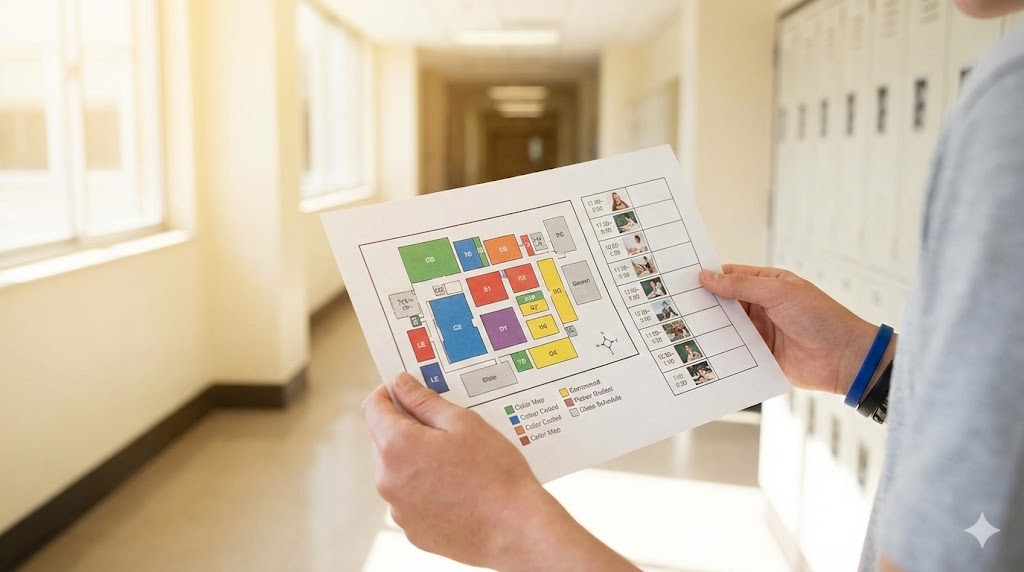
- Ask the school to create a visual schedule or map of your child’s day, including where to go, what to expect, and who to ask for help.
- Discuss providing a consistent aide for transitions and unstructured times (passing periods, lunch, recess). This is not in all IEPs, but it can be critical for middle school success.
- Request that the new school identify one trusted adult (case manager, counselor, or teacher) who your child can go to if overwhelmed.
- Ask about social skills support or peer buddy programs.
- Discuss how the school will handle larger-group instruction if your child needs more support for attention or behavior.
Middle to High School Transitions
By high school, your child should be working on transition services. IDEA requires transition planning by age 16, but Arizona best practice is to start by age 14.
Challenges:
- High school introduces more independence and self-advocacy. Students are expected to move between classes, manage time, ask for help.
- Course selection becomes more complex. Your child might not be in classes with familiar teachers or aides.
- Social dynamics shift again. Middle school friends might not go to the same high school, or social circles change.
- If your child has vocational or life skills goals, the transition to high school is where those come into focus.
What to address in transition planning:
- Discuss transition services (work-based learning, vocational assessment, community-based instruction). Are these in your child’s IEP? Should they be?
- Ask about self-advocacy and self-management skill development. High school is the time to work on your child’s ability to ask for accommodations, manage time, and interact with teachers independently.
- Discuss course loads. Will your child be in general education classes with support, modified general education classes, or a mix? What’s the plan for success?
- Ask about access to assistive technology, if applicable. Laptops for note-taking, speech-to-text, graphic organizers, etc.
- Discuss after-school and community involvement. How will your child access clubs, sports, or activities?
Moving to a New School District
Moving to a new district is the highest-stakes transition because every system is different: policies, procedures, staffing, resources.
Challenges:
- Arizona districts are not standardized. A district in Scottsdale might have very different resources than a rural district.
- The new district might not have the exact services your child receives in the current district. Speech therapy might be once a week instead of twice. Occupational therapy might not be available at all.
- Enrollment processes can be slow. You might not know who your child’s case manager will be until weeks before school starts.
- Your child’s eligibility category might not transfer exactly. The new district might evaluate and determine a different category.
What to address in transition planning:
- Request that the new district’s special education director review your child’s IEP and confirm they can implement it. If they can’t, discuss what modifications are necessary and why.
- Ask about the new district’s overall service model. How do they structure special education? How is caseload managed? What’s the ratio of kids to case managers?
- Discuss any services that might not be available. If your child gets services not offered in the new district, ask for alternatives or a plan to outsource services.
- Request early enrollment meetings (before the official 30-day evaluation period). You want to meet the team, review the IEP, and address concerns before school starts.
- Ask about transportation, enrollment procedures, and any district-specific accommodations or policies.
What NOT to Do During a Transition
- Don’t assume the new school will reach out. You reach out.
- Don’t rely only on verbal communication. Confirm everything in writing.
- Don’t accept vague answers. “We’ll implement the IEP” is not a commitment. “We will provide speech therapy on Tuesdays and Thursdays at 10 a.m.” is.
- Don’t wait until August to get answers. Do this in spring when case managers have time.
- Don’t assume your child will speak up if something is wrong. Not all kids can advocate for themselves. You have to monitor for the first several weeks.
- Don’t assume the receiving school will automatically modify the IEP if your child’s needs have changed. You might need to request an IEP meeting to update it.
My Perspective from the School Side
I know how school transitions work from the inside. When they’re successful, it’s because someone was managing the details — usually the parent or an advocate. The school wasn’t being irresponsible; they were busy with dozens of other transitions happening at the same time.
The schools that do transitions best have clear systems. They assign a transition coordinator. They schedule meetings. They create documentation. They confirm everything in writing.
Most schools don’t have these systems. Transitions happen ad hoc, on goodwill and best intentions. And goodwill doesn’t always translate to a smooth first day for your child.
That’s why you have to be proactive. You’re not being demanding; you’re being responsible. Your child’s right to a free, appropriate public education (FAPE) doesn’t pause during the summer. It continues. And the receiving school has a legal obligation to uphold it on day one.
I’m not here to be polite for the sake of being polite. I’m here to make sure your child gets what the law says they’re entitled to receive. If the receiving school isn’t prepared, I’ll help you address it.
What to Do Next
If your child is transitioning to a new school or district:
- Send a written notification to the current school. Let them know the transition is happening and ask them to coordinate with the receiving school.
- Request a transition planning meeting. Do this in April or May, not August.
- Get the name of your child’s new case manager. Follow up if you don’t hear back.
- Request a tour of the new school. See the actual spaces where your child will spend time.
- Meet with the new case manager before school starts. Bring your one-page summary of your child’s needs. Confirm services are set up.
- Request written confirmation that services are in place. Don’t start the school year on a hope and a prayer.
- Plan to monitor closely the first two weeks. Ask your child daily what happened, where they went, who they worked with. Follow up with the case manager if something doesn’t match the plan.
Transitions can be smooth. But they require planning, communication, and follow-up. Start now.
Let’s Talk
If your child is transitioning to a new school and you want help planning for a smooth transition, or if you’re concerned about how the receiving school is preparing, reach out. I help families navigate transitions and protect their children’s services during these critical moments.
Contact me at alison@stoneeac.com or call 480.973.3553.
Your child’s IEP doesn’t pause for transitions. Let’s make sure the receiving school knows that.