
Walking into your first IEP meeting can feel overwhelming. You’re sitting across the table from a room full of professionals who seem to speak a different language, and you’re expected to make decisions that will shape your child’s education for the next year.
I’ve been in these meetings, and I want you to know something important: you belong at that table. You’re not there as a guest or an observer. You’re there as the expert on your child, and your voice matters just as much as anyone else’s in that room.
Let me walk you through exactly what happens in an IEP meeting, who’s supposed to be there, and how you can prepare to be your child’s most effective advocate.
What Is the Purpose of an IEP Meeting?

An IEP meeting is where your child’s educational team comes together to create, review, or update the Individualized Education Program (IEP). This document is legally binding and outlines exactly what specialized services, supports, and goals your child will receive.
The meeting ensures your child receives a Free Appropriate Public Education (FAPE) in the Least Restrictive Environment (LRE). That means the school must provide the services your child needs while keeping them with their non-disabled peers as much as possible.
Depending on the type of meeting, the team will:
- Determine whether your child is eligible for special education services (initial meeting)
- Assess your child’s current academic and functional performance
- Establish measurable annual goals
- Identify specific special education and related services your child needs
- Discuss accommodations and modifications
- Decide on the appropriate educational placement
- Review and revise the IEP (annual review)
Who Should Be at the IEP Meeting?

Federal law requires specific people to attend IEP meetings. Understanding who should be there helps you know who to expect and who might be missing.
You, the parent or guardian. You’re not optional. You provide insights about your child that no one else can offer, and you have the right to participate in every decision.
A general education teacher. At least one teacher who is or will be responsible for your child’s general education. They bring expertise about grade-level expectations and the general curriculum.
A special education teacher. This person understands how to adapt instruction and curriculum for students with disabilities.
A representative from the school district (LEA/PEA Representative). This is usually an administrator or special education director who can commit district resources. If this person isn’t at the meeting, the school may not be able to agree to certain services.
Someone who can interpret evaluation results. Often the school psychologist, this person explains what the assessments mean for your child’s education.
Your child (when appropriate). Students can and should participate in their IEP meetings, especially as they get older. By age 16, they should definitely be involved in discussions about their future.
Anyone else you want to bring. You have the right to invite people with knowledge about your child, such as a private therapist, doctor, or an advocate like me. Let the school know in advance if you’re bringing someone.
The Step-by-Step Flow of an IEP Meeting
Every meeting is a little different, but here’s what you can typically expect.
1. Introductions and Procedural Safeguards
The meeting usually starts with everyone introducing themselves and their role. You’ll receive a copy of your Procedural Safeguards, which outline your legal rights under IDEA.
I know these documents can be overwhelming, but they matter. If you have questions about your rights, ask. If you don’t understand something, say so. This is your meeting, too.
2. Present Levels of Academic Achievement and Functional Performance (PLAAFP)
This section describes where your child is right now. The team reviews recent evaluations, classroom assessments, teacher observations, and your input to paint a picture of your child’s strengths and areas of need.
This is where your voice is critical. You see your child in ways the school doesn’t. If their description of your child doesn’t match what you see at home, speak up. If they’re missing important information about your child’s abilities or challenges, share it.
3. Reviewing Progress and Setting New Goals
If your child already has an IEP, the team will review how much progress they’ve made on last year’s goals. Then you’ll work together to develop new annual goals.
Good IEP goals should be SMART: Specific, Measurable, Achievable, Relevant, and Time-bound. If a proposed goal is vague or doesn’t address your child’s real needs, ask questions. “How will we measure this?” and “What does success look like?” are perfectly reasonable questions.
4. Determining Special Education and Related Services
This is where the team decides what specialized instruction and related services your child needs. Related services might include:
- Speech-language therapy
- Occupational therapy
- Physical therapy
- Counseling
- Transportation
- Assistive technology
The IEP should specify how often your child receives each service, for how long, and where. “Speech therapy” isn’t enough. You need to know if it’s 30 minutes twice a week in a small group, or 60 minutes once a week one-on-one.
5. Accommodations and Modifications
Accommodations change how your child learns or is tested without changing what they’re expected to learn. Examples include extended time on tests, preferential seating, or access to audiobooks.
Modifications change what your child is taught or expected to learn. Examples include reduced assignments, simplified texts, or different grading criteria.
The team will discuss what accommodations and modifications your child needs to access the curriculum and participate in assessments. Make sure these are specific enough to actually be implemented.
6. Educational Placement (Least Restrictive Environment)
The team must determine where your child will receive services. Under IDEA, your child should be educated with non-disabled peers to the maximum extent appropriate.
Placement options range from full inclusion in general education with support to more specialized settings. If the team recommends removing your child from the general education classroom for any part of the day, they must explain why.
This is an area where I see a lot of parents accept what the school recommends without question. You have the right to ask why a particular placement is being recommended and what alternatives were considered.
7. State and District Assessments
The team will discuss how your child will participate in standardized testing. This might include accommodations (like extended time) or, in some cases, an alternate assessment designed for students with significant cognitive disabilities.
8. Your Input and Concerns
Throughout the meeting, you should be sharing your observations and concerns. But there’s usually a specific point where the team asks for your input directly.
Don’t wait until this moment to speak up. If something doesn’t feel right at any point in the meeting, say so. Your concerns are valid, and addressing them in the moment is more effective than trying to fix things afterward.
9. Finalizing and Signing
Once everything is discussed and agreed upon, the team finalizes the document. You’ll be asked to sign, indicating you attended and understand the IEP.
Important: Signing that you attended is not the same as agreeing with everything in the IEP. If you’re not sure about something, you can ask for time to review the document before giving consent for services to begin.
Types of IEP Meetings

Not all IEP meetings are the same. Here’s what to expect from each type:
Initial IEP Meeting: This happens after your child has been evaluated and found eligible for special education. It’s the first time the team develops an IEP for your child.
Annual Review: Held at least once a year, this meeting reviews your child’s progress, updates the Present Levels section, and revises goals and services for the coming year.
Reevaluation Meeting: Every three years (or sooner if needed), the team reviews whether your child still qualifies for special education and what their current needs are.
Amendment Meeting: You or the school can request a meeting at any time to make changes to the IEP (known as an Addendum). Sometimes minor changes can be made without a full meeting if you agree in writing.
Transition Planning Meeting: Starting at age 14 (or earlier in some cases), these meetings focus on preparing your child for life after high school, including education, employment, and independent living goals.
How to Prepare for an IEP Meeting

Preparation is everything. Here’s what I recommend to every parent I work with:
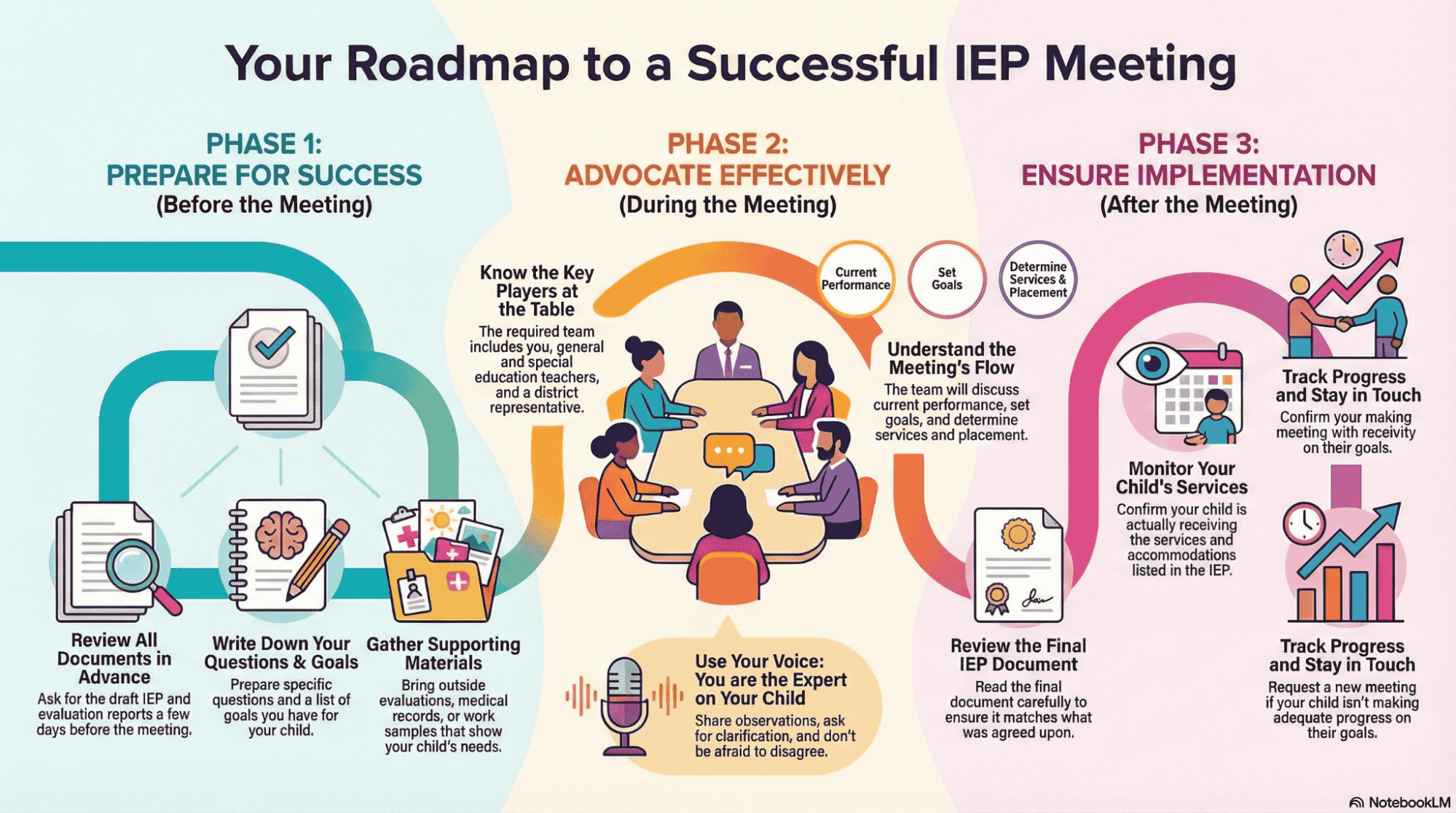
Review all documents beforehand. Ask for copies of evaluation reports, progress reports, and the draft IEP at least a few days before the meeting. Don’t walk in seeing this information for the first time.
Keep a log of your observations. Note specific examples of your child’s progress and challenges at home. Concrete examples are more powerful than general impressions.
Write down your questions. It’s easy to forget what you wanted to ask when you’re in the middle of a meeting. Having a written list keeps you focused.
Think about what you want for your child. What goals do you have for the coming year? What services do you think your child needs? Come with your own ideas, not just reactions to what the school proposes.
Bring supporting documents. If you have outside evaluations, medical records, or work samples that show what your child can do, bring them.
Consider bringing support. You have the right to bring someone with you. This could be a spouse, a trusted friend, or an advocate who can help you navigate the process.
Have an IEP meeting coming up?
Advocating Effectively During the Meeting
Being an effective advocate doesn’t mean being aggressive. It means being prepared, asking good questions, and keeping the focus on your child’s needs.
Ask questions when you don’t understand. “Can you explain what that means?” and “How would that work in the classroom?” are perfectly appropriate questions.
Take notes. Document what’s discussed, what’s agreed upon, and any concerns that come up. These notes can be invaluable later.
Don’t be afraid to disagree. If something doesn’t feel right, say so. “I’m not comfortable with that” or “I’d like to discuss other options” are reasonable responses. You don’t have to accept everything the school proposes.
Stay focused on your child. When discussions get tense or off-track, bringing it back to “What does my child need to succeed?” can refocus the conversation.
Ask for time if you need it. You don’t have to make every decision in the meeting. It’s okay to say, “I’d like to think about this and follow up.”
What to Do After the IEP Meeting

The meeting is just the beginning. Your job isn’t done when you walk out of that room.
Review the final document carefully. Make sure it accurately reflects what was discussed and agreed upon. Errors happen, and catching them early is much easier than fixing them later.
Monitor implementation. An IEP is only as good as its implementation. Pay attention to whether your child is actually receiving the services and accommodations listed in the document.
Track progress. Keep an eye on how your child is doing on their IEP goals. If they’re not making progress, that’s a conversation to have with the school.
Request updates. You don’t have to wait for the annual review to check in. Ask for progress reports and communicate with teachers if you have concerns.
Document everything. Keep copies of all IEP documents, progress reports, and communications with the school in an organized file.
When Things Don’t Go Well

Sometimes IEP meetings don’t go the way you hoped. The school might refuse services you believe your child needs, or you might fundamentally disagree with their recommendations.
If that happens, you have options:
- Request another meeting to continue the discussion
- Ask for the school’s decision in writing (Prior Written Notice)
- Request mediation to work through disagreements
- File a complaint with your state education agency
- Request a due process hearing
These situations are exactly why I do what I do. Navigating disagreements with schools can be stressful and confusing, and having someone in your corner who knows the law and the process can make a real difference.
You Are Your Child’s Best Advocate

IEP meetings can feel intimidating, but remember: you know your child better than anyone in that room. Your insights, your concerns, and your goals for your child matter.
The school has expertise in education. You have expertise in your child. When those two come together effectively, that’s when real progress happens.
If you’re feeling overwhelmed by the IEP process, or if your meetings aren’t going the way you’d hoped, you don’t have to figure it out alone. With over 25 years of experience attending IEP meetings across Arizona, I can help you prepare, advocate effectively, and ensure your child gets the services they’re entitled to under the law.
Ready to talk about your child’s IEP? Call me at 480.973.3553 for a free consultation. I’ll listen to what’s happening and help you figure out the best path forward.
Frequently Asked Questions
Can a parent request an IEP meeting?
Absolutely. You have the right to request an IEP meeting at any time. Put your request in writing to the special education director or your child’s case manager. The school must respond within a reasonable timeframe.
Can an IEP meeting be held without a parent?
Schools are required to make multiple attempts to include parents in IEP meetings. However, if a parent cannot attend and has been given adequate notice and opportunity to participate, the meeting can proceed. If you can’t attend in person, ask about participating by phone or video conference.
Can I record my IEP meeting?
This depends on your state and school district policy. In Arizona, you generally have the right to record if you provide advance notice. Check your district’s policy and notify the school in writing before the meeting if you plan to record.
How long do IEP meetings typically last?
Most IEP meetings last between one and two hours, though complex situations may require more time. If the meeting is running long and decisions are being rushed, you can ask to schedule a continuation meeting.
What if my child isn't making progress on their IEP goals?
If your child isn’t making adequate progress, request a meeting to discuss why. The team may need to adjust goals, change services, or modify how instruction is being delivered. Lack of progress is a serious concern that should be addressed promptly.
How often are IEP meetings held?
At minimum, IEP meetings are held annually to review and update the IEP. Reevaluations occur at least every three years. However, you or the school can request additional meetings at any time if circumstances change or concerns arise.
What should I bring to an IEP meeting?
Bring copies of previous IEPs and evaluations, your written questions and concerns, any relevant medical records or outside evaluations, examples of your child’s work, and something to take notes with. Having an organized binder with all your child’s educational records is invaluable.
Alison Stone is a COPAA-certified special education advocate with over 25 years of experience helping Arizona families navigate IEP meetings and the special education system. At Stone Educational Advocacy & Consulting, she prepares parents for meetings, attends alongside them, and ensures their children receive the services they’re legally entitled to.
Feeling unprepared for your upcoming IEP meeting? Call 480.973.3553 or email alison@stoneeac.com to schedule a consultation. I can help you prepare, attend the meeting with you, or review your child’s IEP to make sure it meets their needs.