If you’ve been following the news about special education policy, you’re probably worried. And honestly? You should be paying attention.
2026 is shaping up to be one of the most significant years for special education in decades. Between potential changes to IDEA, the expiration of pandemic relief funding, shifts in federal oversight, and the continued expansion of school voucher programs, the landscape your child depends on is shifting beneath our feet.
I’m not writing this to scare you. I’m writing this because informed parents make better advocates, and your child is going to need you to understand what’s coming so you can protect their rights.
Let me break down what we know, what we’re watching, and most importantly, what you can do right now to prepare.
The Big Picture: Why 2026 Matters
Several major changes are converging at once:
- IDEA restructuring discussions that could change how special education is funded and overseen
- The expiration of ESSER funds that have been propping up school budgets since the pandemic
- Potential Department of Education reorganization that could affect enforcement of special education law
- Continued expansion of voucher and ESA programs that come with serious trade-offs for students with IEPs
Any one of these would be significant. Together, they represent a fundamental shift that every parent of a child with disabilities needs to understand.
Federal Policy Changes: What’s Being Discussed
IDEA Restructuring
The Individuals with Disabilities Education Act (IDEA) is the federal law that guarantees your child’s right to a Free Appropriate Public Education (FAPE). It’s the foundation everything else is built on.
Current discussions about IDEA include:
Funding consolidation: There’s talk of modifying how federal funds are allocated through IDEA Part B (services for school-age children) and Part D (professional development and research). Changes here could affect how much money actually reaches your child’s classroom.
Oversight adjustments: Some proposals would give states more flexibility in how they implement IDEA. That might sound good in theory, but less federal oversight often means less accountability. When schools know no one is watching, corners get cut.
Enhanced parental involvement: On a more positive note, proposed legislation like S.745 (the “Empowering Families in Special Education Act”) aims to strengthen parental notification and involvement in IEP meetings. I’ll believe it when I see it signed into law, but it’s worth watching.
Department of Education Reorganization
The U.S. Department of Education is potentially facing significant reorganization. What does this mean for special education?
Program changes: The structure and emphasis of special education programs at the federal level could shift, affecting everything from technical assistance to policy guidance.
Enforcement priorities: If federal enforcement of IDEA compliance becomes less of a priority, schools may feel less pressure to provide the services they’re legally required to provide. This is where strong parent advocacy becomes even more critical.
Concerned about how policy changes affect your child?
The Funding Crisis: What Happens When ESSER Money Runs Out

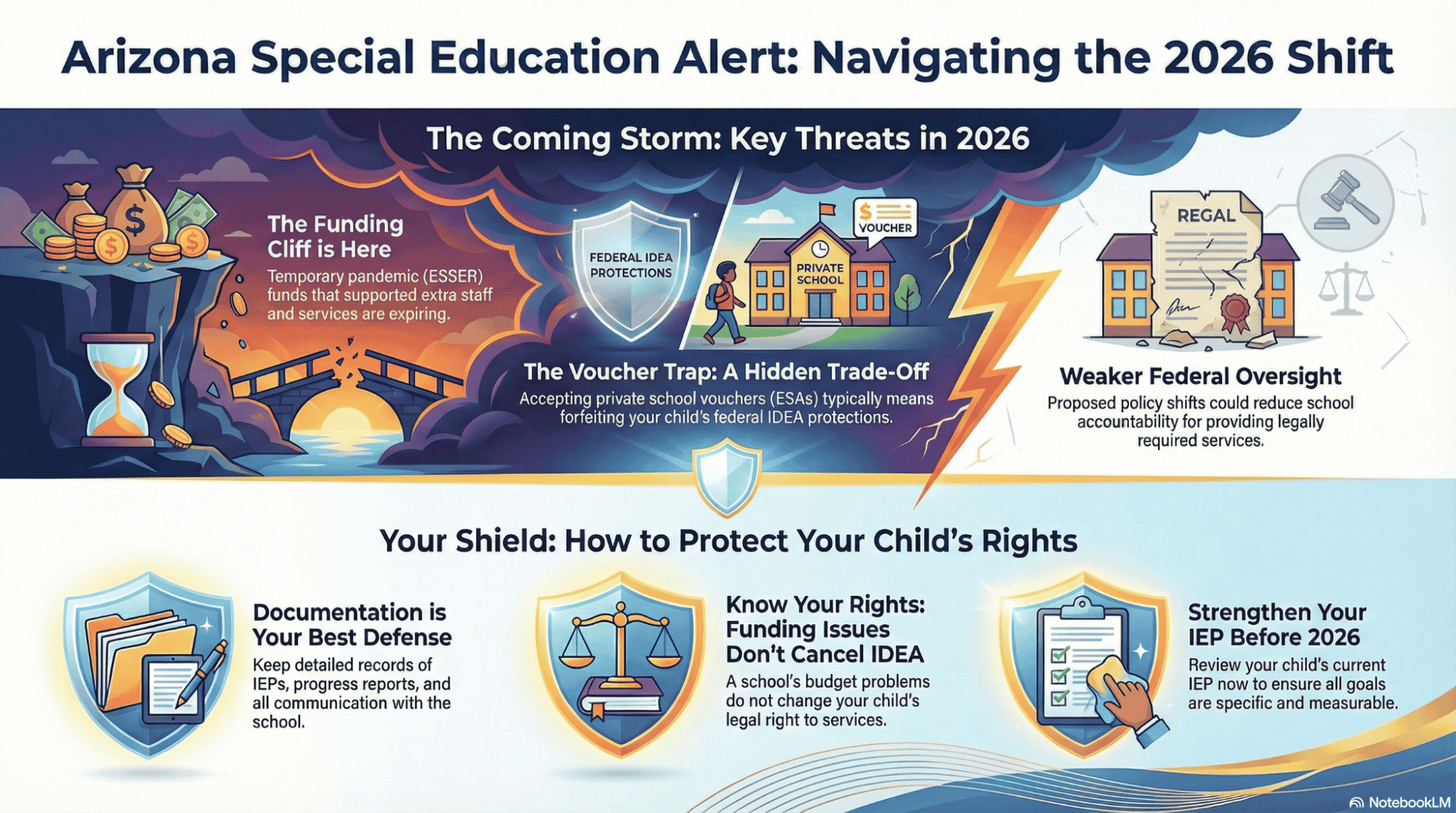
Here’s something that doesn’t get enough attention: many of the special education services your child has been receiving were funded by temporary pandemic relief money. That money is running out.
The ESSER Cliff
Elementary and Secondary School Emergency Relief (ESSER) funds have been supporting:
- Additional special education staff
- Assistive technology purchases
- Extended school year services
- Compensatory education for services missed during the pandemic
When this funding expires, schools will face difficult choices. Some will absorb these costs into their regular budgets. Others won’t. And when budgets get tight, special education services are often the first thing on the chopping block.
Medicaid Reimbursement Changes
Anticipated changes to how schools can be reimbursed through Medicaid for special education-related services could further squeeze budgets. This affects related services like speech therapy, occupational therapy, and counseling.
What This Means for Your Child
I want to be direct with you: some schools are going to try to reduce services, citing budget constraints. This is when knowing your rights matters most.
Budget constraints don’t change your child’s legal entitlements. If your child’s IEP says they receive 60 minutes of speech therapy per week, they’re entitled to 60 minutes of speech therapy per week. Period. The school’s budget problems are not your child’s problem.
If you start hearing phrases like “we can’t afford that anymore” or “we’re restructuring services due to funding,” that’s your cue to get very specific about what your child is legally entitled to under IDEA.
Vouchers and ESAs: The Trade-Off No One Explains
This is the issue I’m most concerned about for Arizona families. With the expansion of Empowerment Scholarship Accounts (ESAs) and other voucher programs, more parents than ever are considering private school options for their children with disabilities.
I understand the appeal. Public school hasn’t worked for your child. You’ve been fighting for years. Someone tells you there’s money available for private school, and it sounds like a lifeline.
But here’s what they don’t tell you upfront: when you accept voucher or ESA money for private school, you typically give up your child’s IDEA protections.
What You Lose with a Voucher
Your right to FAPE disappears. Private schools are generally not subject to IDEA. They’re not required to provide a Free Appropriate Public Education. They can say “we don’t offer that service” and there’s no federal law requiring them to provide it.
Your IEP doesn’t transfer. Private schools don’t have to follow your child’s IEP. Instead, you might get a “service plan” which is negotiated, not mandated. The school decides what they’re willing to offer, not what your child needs.
Due process rights vanish. In public school, if the district refuses to provide what your child needs, you can file for due process. You have legal recourse. In private school with a voucher? Those protections largely disappear.
You may pay out of pocket. Private schools can charge additional fees for services. The voucher amount might not cover everything your child needs, and you have no legal leverage to demand the school provide more.
The Questions You Need to Ask Before Accepting a Voucher
Before you sign anything, get answers in writing:
- What specific special education services does this school provide?
- What are the qualifications of staff who will work with my child?
- How will the school support my child’s IEP goals?
- What happens if my child isn’t making progress?
- What is the dispute resolution process if I disagree with the school’s approach?
- What additional costs will I be responsible for beyond the voucher amount?
I’ve worked with families who made the voucher decision without fully understanding what they were giving up. Some have tried to return to public school, only to face a complicated re-evaluation process to re-establish eligibility.
This is an irreversible decision in many ways. Please understand what you’re trading away before you make it.
State vs. Federal: A Shifting Balance
The relationship between federal oversight and state control of special education is changing. Some proposals would give states significantly more autonomy in how they implement IDEA.
What More State Control Could Mean
Varied service levels: Without strong federal standards, what your child is entitled to could depend more on which state you live in.
Less accountability: Federal oversight, imperfect as it is, provides a backstop when states or districts fail to comply with the law. Less oversight could mean less accountability.
State-specific changes: States like Arizona are already implementing their own special education policies. Staying informed about state legislation is more important than ever.
Staying Informed
I know it’s exhausting to keep track of policy changes on top of everything else you’re dealing with. But knowledge is power in this arena. The parents who know what’s coming are the parents who can protect their children.
Documentation: Your Best Protection During Uncertainty

When policy is in flux and budgets are tight, documentation becomes your most powerful tool. Schools are less likely to cut corners when they know a parent is keeping careful records.
What You Should Be Documenting
Maintain comprehensive records: Keep a centralized file with your child’s current IEP, all evaluation reports, progress reports, all correspondence with the school, discipline records, and assessment results.
Document all communication: After phone calls, send a follow-up email summarizing what was discussed. “I’m writing to confirm our conversation today in which you stated…” creates a paper trail.
Track service delivery: Keep a log of whether your child is actually receiving the services listed in their IEP. Note any missed sessions, substitute providers, or concerns about quality.
Know your notification rights: The school must provide Prior Written Notice before proposing changes to your child’s IEP. If they try to reduce services without proper notification, that’s a violation.
Keep everything. When in doubt, save it. You never know what documentation might matter later.
What You Can Do Right Now

I don’t want you to feel helpless. Here’s what proactive parents are doing to prepare:
Review Your Child’s Current IEP
Look at it with fresh eyes. Is everything your child needs clearly documented? Are services specific enough (frequency, duration, location)? Are goals measurable? The stronger your current IEP, the harder it is for schools to chip away at it.
Understand Your Rights
Make sure you truly understand what your child is entitled to under IDEA. The school’s budget problems don’t change federal law. If someone tells you services have to be cut “because of funding,” know that this isn’t how the law works.
Build Relationships
Now is the time to strengthen communication with your child’s teachers and service providers. People are more likely to advocate for your child when they have a relationship with you.
Stay Informed
Follow developments at both the federal and state level. Policy changes don’t happen overnight, and there’s often time to prepare if you’re paying attention.
Consider Getting an Advocate
If you’re already struggling with your school district, or if you’re facing major decisions like whether to accept a voucher, having someone in your corner who knows the law can make all the difference.
The Bottom Line

2026 is going to be a challenging year for special education. Funding pressures, policy changes, and the continued expansion of voucher programs are creating a landscape that requires parents to be more informed and more vigilant than ever.
But here’s what I want you to remember: your child’s rights under IDEA have not changed. The law still requires schools to provide a Free Appropriate Public Education. The law still requires them to follow your child’s IEP. The law still gives you the right to advocate, to disagree, and to fight for what your child needs.
What’s changing is how hard you might have to fight to enforce those rights. And that’s where I come in.
If you’re worried about how these changes will affect your child, or if you’re facing pressure to accept reduced services, or if you’re trying to decide whether a voucher program is right for your family, I’m here to help you think it through.
Have questions about how 2026 changes might affect your child? Call me at 480.973.3553. I’ve been navigating special education policy for over 25 years, and I can help you understand your options and protect your child’s rights.
Frequently Asked Questions
What are the proposed changes to special education funding in 2026?
Proposed changes include modifications to how federal funds are allocated through IDEA Part B and Part D, plus the significant impact of ESSER fund expiration. Many schools have been relying on temporary pandemic relief money to fund special education services, and that money is running out.
Will IDEA funding be cut in 2026?
While direct cuts to IDEA are being discussed, the more immediate concern is the expiration of ESSER funds and potential restructuring of how federal money is distributed. The practical effect could be reduced services even if IDEA itself isn’t technically “cut.”
What happens to my child's IEP if we use a school voucher?
This is critical to understand: when you use a voucher or ESA for private school, you typically lose IDEA protections. Private schools aren’t required to follow IEPs, provide FAPE, or offer the same due process rights. Services become negotiated rather than legally mandated.
Do private schools have to follow IEPs if we're using a voucher?
Generally, no. Private schools are not subject to IDEA in the same way public schools are. They may offer limited services through a “service plan,” but this is not equivalent to a full IEP with all its legal protections.
How will the Department of Education reorganization affect special education?
Potential reorganization could affect enforcement priorities, technical assistance, and policy guidance for special education. Less federal emphasis on IDEA compliance could mean less accountability for schools that aren’t providing required services.
What is the "Empowering Families in Special Education Act"?
S.745 is proposed federal legislation that would amend IDEA to enhance parental notification and involvement in IEP meetings. It’s designed to strengthen parents’ role in the special education process, though it hasn’t been passed yet.
How can I prepare for potential funding cuts affecting my child's services?
Review your child’s IEP to ensure everything is clearly documented. Understand your rights under IDEA. Document all services and communication with the school. Remember that budget constraints don’t change your child’s legal entitlements. If the school tries to reduce services citing budget issues, that’s when you need to be prepared to advocate strongly.
Should I consider a voucher program for my child with disabilities?
This is a deeply personal decision that depends on your specific situation. Before accepting any voucher or ESA money, make sure you fully understand what legal protections you’re giving up. Get answers in writing from any private school about what services they’ll provide and what you’ll be responsible for. Consider consulting with an advocate before making this decision.
Alison Stone is a COPAA-certified special education advocate with over 25 years of experience helping Arizona families navigate the special education system. At Stone Educational Advocacy & Consulting, she helps parents understand their rights, prepare for policy changes, and ensure their children receive the services they’re legally entitled to.
Concerned about how 2026 changes will affect your child? Call 480.973.3553 or email alison@stoneeac.com for a consultation. I can help you understand your options and develop a plan to protect your child’s educational rights.