
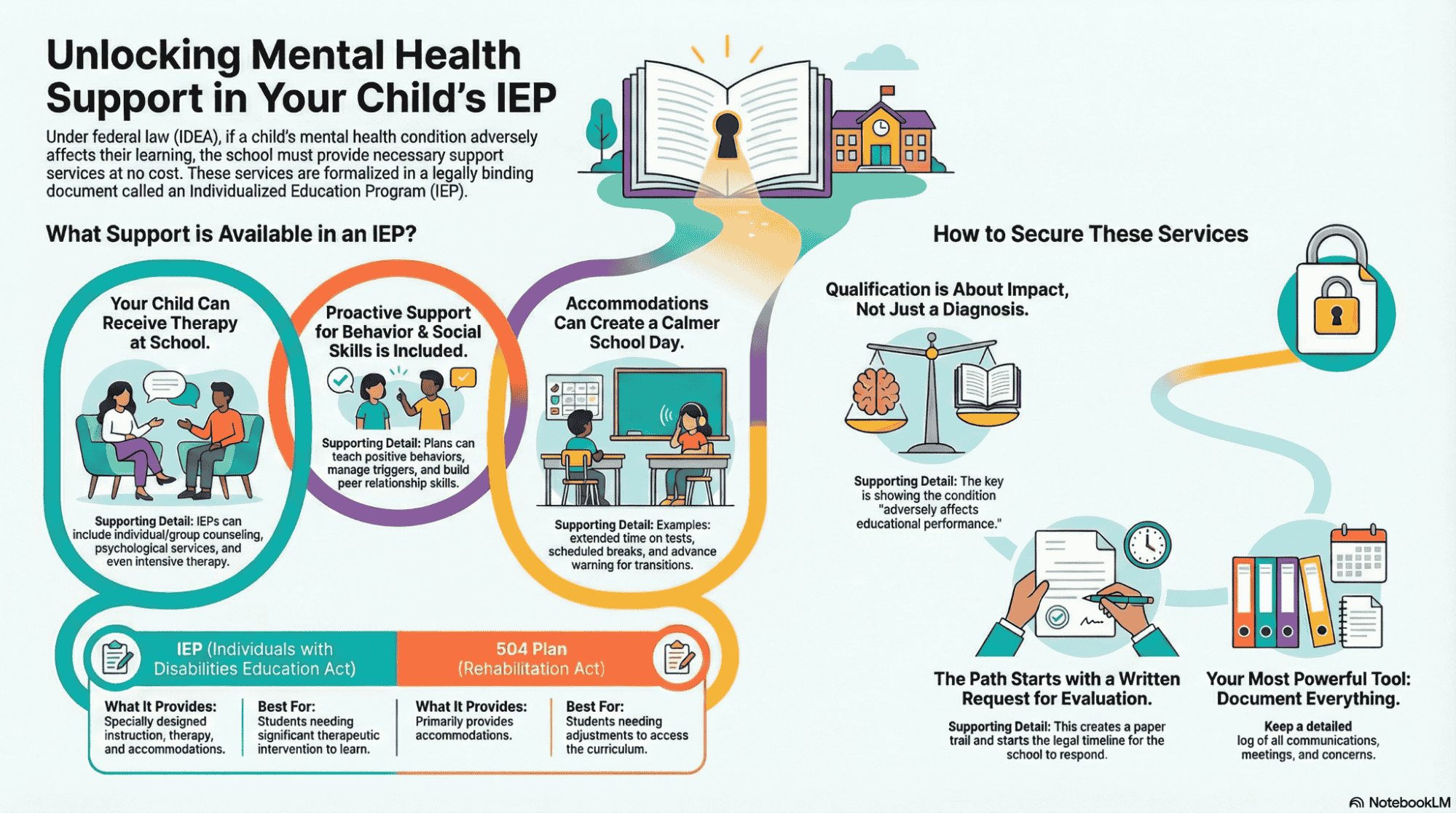
If your child is struggling with anxiety, depression, trauma, or other mental health challenges that are affecting their ability to learn and thrive at school, you need to know this: under federal law, your child may be entitled to mental health services as part of their Individualized Education Program (IEP).
I work with families every week who had no idea these services existed. They thought their only options were private therapy on their own dime or hoping the school counselor could squeeze in a few minutes here and there. But the reality is that your child has legal rights to comprehensive mental health support—and I want to make sure you understand exactly what those rights include.
The past few years have been brutal on our kids. The pandemic didn’t just disrupt their education—it fundamentally changed their mental health landscape. In 2026, schools are under more pressure than ever to address these needs, and as a parent, you’re in a stronger position than you might realize to demand the support your child deserves.
Let me walk you through what’s available, how your child qualifies, and what you can do to make sure they get every service they’re entitled to.
Understanding Your Child’s Rights: IDEA, IEPs, and Mental Health in 2026
The Individuals with Disabilities Education Act (IDEA) is the federal law that guarantees your child’s right to a Free Appropriate Public Education (FAPE). What many parents don’t realize is that FAPE isn’t just about academics—it includes “related services,” which are the supportive services your child needs to actually benefit from their education.
Mental health services fall squarely within this definition.
Here’s what this means for you: If your child has a mental or emotional health condition that significantly impacts their ability to learn, participate in school, or access their education, the school district is legally required to provide the mental health services necessary to address that impact. These services must be written into your child’s IEP and provided at no cost to you.
An IEP isn’t a suggestion—it’s a legally binding document. Once mental health services are included in your child’s IEP, the school must provide them. Period.
What Types of Mental Health Services Can Be Included in an IEP?
I often sit down with parents who have no idea how extensive the range of available services actually is. Here’s what your child’s IEP can include:
School Counseling (Counseling Services IEP) A qualified school counselor provides individual or group support to help your child develop social skills, manage emotions, build self-esteem, and navigate academic or personal challenges. This isn’t just “check-in” time—it’s structured, goal-directed support.
Psychological Services School psychologists can provide individual or group counseling, crisis intervention, and help develop positive behavioral intervention strategies. They also conduct functional behavioral assessments (FBAs) to understand why certain behaviors are happening and how to address them.
Social Work Services School social workers help address the bigger picture—connecting your family with community resources, facilitating communication between home and school, and tackling issues like housing instability, family stress, or other factors impacting your child’s ability to succeed academically and socially.
Social Skills Groups These structured groups teach your child how to interact with peers, read social cues, manage conflict, and build healthy relationships. For kids whose mental health challenges affect their social functioning, these groups can be transformative.
Educationally Related Intensive Counseling Services (ERICS/ERMHS) For children with more significant mental health needs, ERICS provides a higher level of therapeutic support within the school environment. This often includes individual and family counseling from licensed mental health professionals—not just school staff.
Behavioral Intervention Plans (BIPs) When challenging behaviors stem from a mental health condition, a BIP outlines proactive strategies to teach positive behaviors, manage triggers, and provide consistent responses. A good BIP doesn’t just react to behaviors—it prevents them.
Accommodations and Modifications These are specific adjustments designed to support your child’s mental well-being and academic access. An anxiety accommodation IEP, for example, might include preferential seating near the door, extended time on assignments, scheduled or on-demand breaks, reduced workload, advance warning about transitions, or explicit instruction in coping strategies like deep breathing.
Crisis Intervention This is immediate support during a mental health crisis at school, ensuring your child’s safety and connecting them with necessary care.
Family Support and Consultation Schools can consult with you to share strategies, provide resources, and ensure consistency between what happens at school and what happens at home.
Medication Management Oversight While schools don’t prescribe medication, they can oversee the administration of prescribed medication and monitor its educational impact through coordination with an Individualized Health Plan (IHP).
Your child deserves mental health support.
Does Your Child Qualify? Understanding IEP Eligibility for Mental Health Services

Here’s something that trips up a lot of parents: having a mental health diagnosis doesn’t automatically qualify your child for an IEP.
The key question is whether your child’s mental or emotional health condition adversely affects their educational performance to the extent that they need specially designed instruction and related services to access their education.
This doesn’t just mean grades. “Educational performance” includes your child’s ability to attend school, participate in class, interact with peers, regulate emotions, complete assignments, and function in the school environment. If anxiety keeps your child from entering the building, that’s an impact on educational performance. If depression means they can’t concentrate or complete work, that’s an impact. If trauma responses lead to behavior that gets them removed from class, that’s an impact.
How the Qualification Process Works
Step 1: Referral You, a teacher, or other school staff can refer your child for an evaluation if there’s a suspicion that a disability is impacting their learning. My recommendation: always put this request in writing. It creates a paper trail and starts the legal timeline for the school to respond.
Step 2: Comprehensive Evaluation Once you provide written consent, the school district must conduct a thorough, multidisciplinary evaluation. This goes beyond academics to include social-emotional functioning, psychological assessments, behavioral observations, and developmental history. The evaluation should paint a complete picture of how your child’s mental health is affecting their ability to learn and function at school.
Step 3: Eligibility Determination The IEP team (which includes you as an equal member) determines whether your child meets criteria under one of IDEA’s 13 disability categories. For mental health conditions, the most common categories are:
- Emotional Disturbance (ED): This category covers conditions like anxiety, depression, and other emotional conditions that adversely affect educational performance over a prolonged period. It includes inability to learn not explained by other factors, difficulty maintaining relationships, inappropriate behaviors or feelings, pervasive unhappiness or depression, and physical symptoms or fears related to school.
- Other Health Impairment (OHI): This broader category includes conditions like ADHD, anxiety, and depression that result in limited strength, vitality, or alertness—including heightened alertness to environmental stimuli—that adversely affects educational performance.
Can Anxiety or Depression Qualify My Child for an IEP?
Yes. Absolutely yes.
I work with families all the time whose children have anxiety or depression that significantly impacts their ability to function at school. If your child’s anxiety makes them unable to attend school, participate in class, complete assignments, or interact with peers, and if they need specially designed instruction or therapeutic services (not just accommodations) to access their education, they can qualify for an IEP under either Emotional Disturbance or Other Health Impairment.
The school may try to push you toward a 504 Plan instead. Sometimes that’s appropriate—but sometimes it’s not. Let me explain the difference.
IEP vs. 504 Plan: Which Does Your Child Need?

I get this question constantly, and it matters—because the wrong plan can leave your child without the support they need.
The Legal Framework An IEP is governed by IDEA, a federal special education law that provides comprehensive protections and services. A 504 Plan is governed by Section 504 of the Rehabilitation Act, a civil rights law that prevents discrimination but doesn’t require the same level of services.
Eligibility Differences For an IEP, your child must have one of IDEA’s 13 disability categories AND require specially designed instruction and related services. For a 504 Plan, your child just needs a physical or mental impairment that substantially limits a major life activity (including learning, concentrating, or thinking)—but they don’t need special education services.
What You Get An IEP provides specially designed instruction, related services (like counseling, psychological services, and intensive therapeutic support), AND accommodations. A 504 Plan primarily provides accommodations—extended time, preferential seating, reduced workload—but generally doesn’t include intensive, ongoing therapeutic services like ERICS.
The Bottom Line If your child’s mental health condition primarily requires accommodations to access learning—and they can succeed in the regular education environment with those adjustments—a 504 Plan may be sufficient. But if the condition profoundly impacts learning, requires significant therapeutic interventions, or necessitates changes to how your child is taught, an IEP is the more appropriate path.
Don’t let the school push you toward a 504 Plan just because it’s easier for them. If your child needs more than accommodations, push back.
What This Looks Like in Practice: Real Examples

Let me show you how these services actually work in the real world:
School Counseling in Action A high school student dealing with depression receives weekly individual counseling focused on goal-setting, identifying negative thought patterns, and developing healthy coping mechanisms. Their IEP includes specific, measurable goals around emotional regulation and academic re-engagement.
Social Work Services in Action A child whose family is experiencing housing insecurity has chronic absenteeism and significant anxiety. The school social worker connects the family with community resources while working with the school to implement flexible attendance policies as an accommodation.
ERICS in Action A middle schooler diagnosed with clinical depression receives regular, intensive individual counseling with a licensed therapist provided by the school district. The focus: coping strategies, emotional regulation, and symptom management that directly impact their ability to attend school and learn.
Anxiety Accommodation IEP in Action A student with generalized anxiety disorder experiences panic attacks during tests. Their IEP includes:
- Preferential seating near the door for easier exit if needed
- Extended time on assessments to reduce pressure
- Scheduled or on-demand breaks to a designated calming space
- Reduced workload when overwhelmed
- Advance warning for transitions or changes in routine
- Explicit instruction in coping strategies like deep breathing and mindfulness
BIP for Mental Health in Action A child whose anxiety manifests as school refusal has a BIP outlining a staggered re-entry plan, a designated “safe person” at school, and positive reinforcement for attendance milestones. The plan addresses the underlying anxiety, not just the behavior.
The 2026 Landscape: Post-Pandemic Mental Health Emphasis

The COVID-19 pandemic dramatically amplified the mental health crisis among children and adolescents. If you’re reading this in 2026, you’re parenting in the aftermath of that crisis—and schools are still catching up.
Here’s what I’m seeing change:
Enhanced Training for School Staff More educators, counselors, and administrators are receiving training in mental health first aid, suicide prevention, and recognizing signs of distress. This means more eyes watching for kids who need help.
Increased Collaboration with Community Providers Schools are building stronger partnerships with external mental health agencies to facilitate referrals and integrated care. This is especially important for services that extend beyond what schools can legally or practically provide.
Data-Driven Approaches Schools are using screening tools and data to identify at-risk students and track intervention effectiveness. This is a double-edged sword—it can help identify needs earlier, but you want to make sure the data is being used to provide services, not just document problems.
Focus on Prevention and Early Intervention Beyond reactive services, there’s growing emphasis on universal social-emotional learning programs and early intervention to build resilience and coping skills for all students.
The overarching trend in 2026 is toward more comprehensive, integrated, and proactive mental health support. But trends don’t help your child if you don’t know how to advocate for what they specifically need. That’s where you come in.
Financial Considerations: Who Pays for IEP Mental Health Services?
This is critical to understand: IEP services are provided at no cost to you.
School districts bear primary responsibility for funding related services necessary for your child to benefit from special education under IDEA. The school’s obligation to provide FAPE is independent of your insurance status or ability to pay.
That said, districts can sometimes bill Medicaid for certain services provided to eligible students. If your child is Medicaid-eligible, the school may seek reimbursement—but this should never restrict or delay services mandated by the IEP.
A few things to watch for:
- The school cannot require you to enroll in Medicaid to receive services
- Medicaid billing cannot be used as an excuse to delay services
- Private insurance cannot be billed without your consent
- Your refusal to consent to insurance billing cannot result in denial of services
If the school tries to make funding contingent on your cooperation with insurance billing, push back. Your child’s right to services is not negotiable.
How to Advocate for Mental Health Services in Your Child’s IEP
I’ve been helping families navigate this process for over 25 years. Here’s what I recommend:
What the IEP Team Should Consider
When developing an IEP for mental health needs, advocate for the team to address:
Holistic Assessment: The evaluation should thoroughly assess all aspects of your child’s mental health and its impact on their educational functioning—not just academics. Social functioning, emotional regulation, attendance, participation—all of it matters.
Functional Needs: How does the mental health condition affect your child’s daily ability to participate in and benefit from school? This includes attendance, social interaction, emotional regulation, and task completion.
Appropriate Goals: Push for specific, measurable goals that address identified mental health needs and lead to improved educational outcomes. Vague goals like “student will improve emotional regulation” aren’t good enough.
Evidence-Based Services: Advocate for interventions backed by research and tailored to your child’s specific diagnosis and needs.
Collaboration and Communication: Ensure clear communication between school, family, and any outside mental health providers. Your child needs a consistent support system, not fragmented care.
Crisis Plan: For students with significant mental health needs, a detailed crisis plan is essential. This should be in the IEP or attached to it.
Progress Monitoring: Demand clear methods for tracking progress toward mental health goals and regular data-driven discussions.
Practical Advocacy Tips for 2026
Document everything. Keep a detailed log of all communications, meetings, and concerns. Follow up verbal requests with written emails or letters. Paper trails matter.
Be specific in your requests. Don’t just ask for “counseling”—specify what type, how often, and why it’s necessary based on your child’s needs and evaluation data.
Bring support to meetings. You have the right to bring a special education advocate, attorney, or trusted person to IEP meetings. They can provide emotional support, take notes, and help you articulate your position.
Know your rights. Familiarize yourself with IDEA and Arizona’s special education regulations. Understanding your parental rights empowers you to participate effectively.
Seek outside expertise. If you have concerns about the school’s evaluation or proposed services, you can request an Independent Educational Evaluation (IEE) at public expense. Private evaluations can provide valuable leverage in IEP discussions.
Aim for collaboration—but be prepared to dispute. I always encourage families to work collaboratively with schools. But if an agreement can’t be reached, understand your right to dispute decisions through mediation or due process.
When You Need Help
Navigating mental health services in IEPs can be overwhelming, especially when you’re already worried about your child. The terminology is confusing, the process is bureaucratic, and schools don’t always make it easy to access what your child is entitled to.
You don’t have to figure this out alone.
If you’re feeling lost, if the school is pushing back on services you know your child needs, or if you just want someone experienced in your corner during IEP meetings, I’m here to help. I’ve spent over 25 years helping Arizona families secure the mental health services their children are legally entitled to receive.
Ready to talk about your child’s situation? Call me at 480.973.3553 or schedule a consultation to discuss your options.
Your child’s mental health matters. Their education matters. And their legal rights to support in both areas are worth fighting for.
Frequently Asked Questions
What types of mental health services can be included in an IEP?
An IEP can include a wide range of mental health services: school counseling, psychological services, social work services, social skills groups, Educationally Related Intensive Counseling Services (ERICS), Behavioral Intervention Plans (BIPs), accommodations for anxiety or other conditions, crisis intervention, family consultation, and medication management oversight. The specific services depend on your child’s individual needs and what the evaluation shows they require to access their education.
How does a child qualify for mental health services in an IEP?
Your child qualifies if a mental or emotional health condition adversely affects their educational performance to the extent that they need specially designed instruction and related services. The process involves a referral, a comprehensive evaluation, and meeting criteria under an IDEA disability category—typically Emotional Disturbance or Other Health Impairment for mental health conditions like anxiety or depression.
What's the difference between an IEP and a 504 Plan for mental health?
An IEP (under IDEA) provides specially designed instruction, related services like counseling and psychological support, and accommodations. A 504 Plan (under Section 504) primarily provides accommodations for students who have a disability limiting a major life activity but don’t need special education services. If your child needs intensive therapeutic support—not just accommodations—an IEP is likely the better fit.
Can anxiety or depression qualify my child for an IEP?
Yes. Anxiety or depression can qualify your child for an IEP if these conditions adversely affect their educational performance and require specially designed instruction and related services. They typically fall under the disability categories of Emotional Disturbance or Other Health Impairment.
What should I push for in an IEP meeting focused on mental health?
Push for holistic assessment of all mental health impacts, clear functional goals, evidence-based services, strong communication between school and outside providers, a crisis plan if needed, and meaningful progress monitoring. Be specific about what services you’re requesting and why they’re necessary based on evaluation data.
Helping Arizona families navigate special education advocacy for over 25 years. COPAA certified. Here when you need me.
Stone Educational Advocacy & Consulting 480.973.3553 | alison@stoneeac.com | stoneeac.com