If you’ve just learned that your child might qualify for educational support, you’re probably hearing two terms tossed around: IEP and 504 Plan. Maybe a teacher mentioned one, a pediatrician suggested the other, or you’ve been researching online at 2am trying to figure out what your child needs.
Here’s what I want you to know: both of these plans exist to help your child succeed in school. But they’re different tools designed for different situations, and understanding which one fits your child’s needs can make all the difference in the support they receive.
I’ve spent over 25 years helping Arizona families navigate this exact decision. Let me break down what each plan offers, who qualifies, and how to determine which path is right for your child.
Understanding the Legal Foundations

Before diving into the specifics, it helps to understand where these plans come from. They’re rooted in two different federal laws, and that distinction matters.
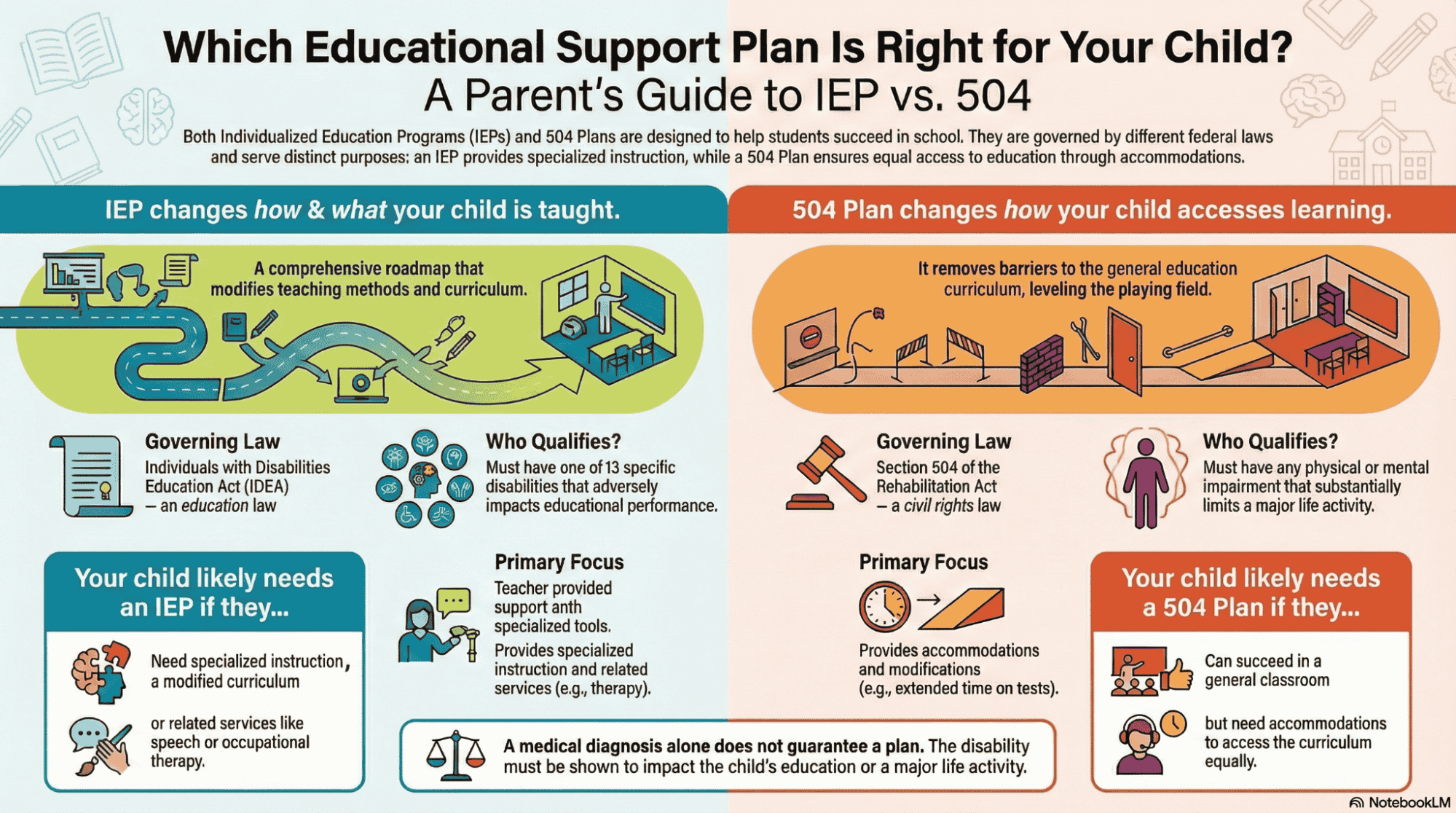
The Individuals with Disabilities Education Act (IDEA) governs IEPs. This law ensures that children with disabilities receive a Free Appropriate Public Education (FAPE) that includes special education and related services tailored to their unique needs.
Section 504 of the Rehabilitation Act of 1973 is a civil rights law that prohibits discrimination based on disability. A 504 Plan ensures students with disabilities have equal access to the general education curriculum and school activities.
The key difference? IDEA is an education law that provides specialized instruction. Section 504 is a civil rights law that provides accommodations to level the playing field.
What Is an Individualized Education Program (IEP)?
An IEP is a legally binding document under IDEA for public school children who need specialized instruction and related services because their disability significantly impacts their educational performance.
Think of an IEP as a comprehensive roadmap for your child’s education. It doesn’t just provide accommodations; it fundamentally changes how and what your child is taught.
Who Qualifies for an IEP?
To qualify for an IEP, your child must meet two criteria:
- Have a disability that falls under one of IDEA’s 13 categories: These include Autism, Specific Learning Disability, Emotional Disturbance, Other Health Impairment (which includes ADHD), Speech or Language Impairment, Intellectual Disability, and others.
- The disability must adversely impact educational performance AND require specialized instruction. This is crucial. A diagnosis alone doesn’t qualify your child. The school must determine that your child needs specially designed instruction to make progress.
What Does an IEP Provide?
An IEP can include:
- Specialized Instruction: This means changes to teaching methods, curriculum adjustments, or different approaches to how your child learns. Your child might receive instruction in a resource room, have a modified curriculum, or work with specialized teachers.
- Related Services: These are support services your child needs to benefit from special education. Examples include speech therapy, occupational therapy, physical therapy, counseling, and psychological services.
- Modifications: Changes to what your child is taught or expected to learn. For example, reduced assignments, altered curriculum content, or different grading standards.
- Accommodations: Changes to how your child learns or is tested, such as extended time, preferential seating, or access to audiobooks.
- Measurable Annual Goals: Your child’s IEP includes specific, measurable goals and tracks progress throughout the year.
Who Develops the IEP?
The IEP is developed by a team that includes you, your child’s general education teacher, a special education teacher, a school district representative, someone who can interpret evaluation results, related service providers, and in some cases, your child. You are an equal member of this team, and your input matters.
IEPs are reviewed at least annually and your child is re-evaluated at least every three years.
What Is a 504 Plan?
A 504 Plan is a document under Section 504 of the Rehabilitation Act that provides accommodations and supports so your child can access the general education curriculum on equal footing with their peers.
A 504 Plan doesn’t change what your child learns. It removes barriers so your child can learn alongside everyone else.
Who Qualifies for a 504 Plan?
The eligibility criteria for a 504 Plan are broader than for an IEP. Your child qualifies if they have:
- A physical or mental impairment that substantially limits one or more major life activities. Major life activities include learning, reading, concentrating, thinking, communicating, walking, seeing, hearing, breathing, and caring for oneself.
This means conditions like ADHD, anxiety, depression, diabetes, dyslexia, chronic health conditions, and many others can qualify your child for a 504 Plan, even if they don’t meet the stricter IEP criteria.
What Does a 504 Plan Provide?
A 504 Plan primarily provides accommodations such as:
- Extended time on tests and assignments
- Preferential seating
- Frequent breaks
- Access to notes or recordings
- Modified homework assignments
- Quiet testing environment
- Use of assistive technology
- Health-related accommodations (for conditions like diabetes or severe allergies)
A 504 Plan does not include specialized instruction or formal annual goals. It’s designed to give your child equal access, not a different educational approach.
Who Develops the 504 Plan?
A 504 Plan is developed by a team that typically includes you, your child’s general education teacher, and the school’s 504 Coordinator. The process is generally less formal than the IEP process, and the plan is usually reviewed annually.
IEP vs. 504 Plan: A Side-by-Side Comparison
| Feature | IEP | 504 Plan |
| Legal Basis | Individuals with Disabilities Education Act (IDEA) | Section 504 of the Rehabilitation Act of 1973 |
| Type of Law | Education law (entitlement to special education) | Civil rights law (prevention of discrimination) |
| Purpose | Provide specialized instruction; child learns differently | Ensure equal access; child learns equally |
| Definition of Disability | One of IDEA’s 13 categories AND requires specialized instruction | Any impairment substantially limiting a major life activity |
| Eligibility | Disability adversely impacts educational performance AND requires special education | Disability substantially limits a major life activity, requiring accommodations |
| Focus | Child’s individualized educational needs and academic progress | Removing barriers to participation in general education |
| Services | Specialized instruction, related services, modifications, accommodations | Primarily accommodations |
| Goals | Includes measurable annual goals | Typically does not include formal goals |
| Plan Detail | Highly detailed, legally binding document | Less detailed, outlines necessary accommodations |
| Team Members | IEP Team (parents, special ed teacher, general ed teacher, administrator, evaluators) | 504 Team (parents, general ed teacher, 504 coordinator) |
Not sure which plan is right for your child?
Which Does Your Child Actually Need?

This is the question I help families answer every day. The decision depends on the nature and impact of your child’s disability on their education.
Your Child Likely Needs an IEP If:
- Their disability falls under one of IDEA’s 13 categories
- The disability significantly impacts their learning or progress in the general curriculum
- They need specialized instruction, meaning changes to what is taught or how it’s taught
- They need related services like speech therapy, occupational therapy, or counseling to access their education
Real-world examples: A child with dyslexia who needs a specialized reading program like Orton-Gillingham. A child with autism who needs social skills instruction and a behavior intervention plan. A child with a significant learning disability who is struggling with foundational math concepts despite classroom interventions.
Your Child Likely Needs a 504 Plan If:
- Their disability substantially limits one or more major life activities (including learning and concentrating)
- They don’t necessarily need specialized instruction but do need accommodations to participate equally
- They can succeed in the general education curriculum with adjustments to how they access it
Real-world examples: A student with ADHD who needs extended time on tests, preferential seating, and movement breaks. A student with dyslexia who can access grade-level content with audiobooks, text-to-speech software, and extra time on written assignments. A child with severe anxiety who needs a quiet testing environment and permission to take breaks. A student with diabetes who needs health accommodations and flexibility for medical needs.
Common Misconceptions I Want to Clear Up
“An IEP is always better than a 504 Plan.”
This is one of the biggest myths I encounter. Neither plan is inherently “better.” The right plan is the one that matches your child’s needs.
A 504 Plan is absolutely sufficient for many students who need accommodations but not specialized instruction. In fact, pushing for an IEP when your child only needs a 504 Plan can sometimes result in an unnecessarily restrictive placement or services your child doesn’t actually need.
“A 504 Plan is only for minor issues.”
Not true. A 504 Plan addresses any physical or mental impairment that substantially limits a major life activity. That’s not minor. Students with serious chronic health conditions, significant ADHD, severe anxiety, and many other conditions thrive with well-implemented 504 Plans.
“Can a child have both an IEP and a 504 Plan?”
No. If your child qualifies for an IEP under IDEA, all necessary accommodations are included in that document. An IEP provides more comprehensive support, so a separate 504 Plan isn’t needed.
However, a child might transition from one plan to another if their needs change over time. I’ve worked with families whose children started with an IEP and transitioned to a 504 Plan as they developed stronger skills, and vice versa.
“Once my child has a plan, we’re set.”
Both plans require ongoing attention. An IEP must be reviewed annually and your child must be re-evaluated at least every three years. A 504 Plan should also be reviewed regularly. More importantly, you should be monitoring whether the plan is actually being implemented and whether it’s working.
If you’re not seeing progress, or if teachers aren’t following the plan, that’s a problem that needs to be addressed.
Your Rights as a Parent

Whether your child has an IEP or a 504 Plan, you have important rights:
- The right to request an evaluation if you suspect your child needs support
- The right to participate in all meetings about your child’s plan
- The right to review all educational records
- The right to disagree with the school’s decisions and request dispute resolution
Don’t let anyone make you feel like you’re just along for the ride. You know your child better than anyone, and your voice matters in these decisions.
How to Request Support for Your Child
If you believe your child needs either an IEP or a 504 Plan, here’s what to do:
- Submit a written request to your school’s principal or special education director. Be specific about your concerns and request an evaluation for special education services (if you suspect an IEP is needed) or a Section 504 evaluation.
- The school conducts an evaluation. They’ll assess your child across multiple areas to understand their needs.
- The team determines eligibility. You’ll meet with school staff to review the evaluation results and determine if your child qualifies for an IEP, a 504 Plan, or neither.
- If eligible, the team develops the plan. You’ll work together to determine what supports your child needs.
- Implementation and review. The plan goes into effect, and its effectiveness should be monitored and reviewed regularly.
Throughout this process, remember: you are a member of the team. If something doesn’t feel right, speak up. If you don’t understand something, ask questions. And if you need support navigating the process, that’s exactly what I’m here for.
When to Seek Help
The IEP and 504 process should be collaborative, but I won’t sugarcoat it: sometimes it’s not. Schools have limited resources, staff may not fully understand the law, and parents can feel overwhelmed or dismissed.
If you’re experiencing any of the following, it might be time to bring in an advocate:
- The school is denying your request for an evaluation
- You don’t understand what the school is proposing
- You feel like the school isn’t listening to your concerns
- Your child’s plan isn’t being implemented
- You disagree with the school’s eligibility determination
- You’re heading into a meeting and want someone in your corner
I’ve helped hundreds of Arizona families navigate these exact situations. Sometimes just having someone who knows the law and can speak the school’s language makes all the difference.
Taking the Next Step
Understanding the difference between an IEP and a 504 Plan is the first step toward getting your child the support they need. But every child is different, and the right path forward depends on your child’s unique situation.
If you’re not sure which plan your child needs, or if you’re struggling to get the school to evaluate your child, I’m here to help. With over 25 years of experience advocating for children with disabilities in Arizona schools, I can help you understand your options, prepare for meetings, and make sure your child’s rights are protected.
Ready to talk about your child’s situation? Call me at 480.973.3553 for a free consultation. I’ll listen to what’s happening and help you figure out the best path forward.
Frequently Asked Questions
What is the difference between an IEP and a 504 Plan?
An IEP provides specialized instruction and related services under IDEA for children whose disabilities significantly impact their educational performance. A 504 Plan provides accommodations under Section 504 to ensure equal access to the general education curriculum. The key difference is that an IEP changes how and what your child is taught, while a 504 Plan removes barriers so your child can learn alongside peers.
Does ADHD qualify for an IEP or 504 Plan?
ADHD can qualify for either, depending on the impact. If ADHD substantially limits your child’s learning but they can succeed with accommodations (like extended time or movement breaks), a 504 Plan may be appropriate. If ADHD significantly impacts educational performance and your child needs specialized instruction or related services, an IEP under the “Other Health Impairment” category may be needed.
Can a school deny a 504 Plan?
Yes, a school can deny a 504 Plan if their evaluation determines your child’s impairment doesn’t substantially limit a major life activity. However, if you disagree with their decision, you have the right to challenge it. Request the denial in writing and consider seeking an independent evaluation or filing a complaint.
Is a 504 Plan permanent?
A 504 Plan remains in effect as long as your child continues to have a disability that substantially limits a major life activity and needs accommodations. It should be reviewed periodically (typically annually) to ensure it still meets your child’s needs. As your child’s needs change, the plan can be modified or discontinued.
What are examples of 504 accommodations?
Common 504 accommodations include extended time on tests, preferential seating, frequent breaks, access to notes or recordings, use of a calculator or other assistive technology, modified homework assignments, quiet testing environment, permission to leave class for medical needs, and flexibility with attendance for health-related appointments.
How do I request an IEP or 504 evaluation?
Submit a written request to your school’s principal or special education director. Clearly state your concerns about your child and specifically request an evaluation for special education services (for a potential IEP) or a Section 504 evaluation. Keep a copy of your request and send it via certified mail or get a signed receipt.
Alison Stone is a COPAA-certified special education advocate with over 25 years of experience helping Arizona families navigate IEPs, 504 Plans, and the special education system. At Stone Educational Advocacy & Consulting, she guides parents through evaluations, eligibility meetings, plan development, and dispute resolution.
Have questions about whether your child needs an IEP or 504 Plan? Call 480.973.3553 or email alison@stoneeac.com to schedule a free consultation.