As a parent, you already know when something feels off. You’ve watched your child struggle while their classmates move ahead. You’ve spent nights worrying, researching, wondering if you’re overreacting or if your concerns are valid.
Here’s what I want you to know: Your instincts matter. And you’re not alone.
As a special education advocate, I work with families every day who are trying to figure out if their child needs additional support. The signs aren’t always obvious, and the special education process can feel overwhelming—but recognizing these warning signs early can change the trajectory of your child’s education.
Right now, 7.9 million students ages 3-21 receive special education services under IDEA—that’s 15.2% of all public school students. This number has grown 3.4% from the previous year, not because disabilities are increasing, but because we’re getting better at identifying and supporting children who need help.
If you’re reading this because you’re concerned about your child, you’re already taking the first step toward getting them the support they deserve.
Understanding Special Education in 2025
Before we dive into warning signs, you need to know what special education actually means. Special education isn’t a place—it’s a service. It’s specialized instruction designed to meet your child’s unique needs when the general education curriculum alone isn’t enough.
To qualify for special education services, three things must be true:
- Your child must have one of 13 qualifying disabilities under IDEA
- The disability must adversely affect their educational performance
- Your child requires specially designed instruction that general education can’t provide
Having a diagnosis doesn’t automatically qualify a child for special education. The condition must impact their ability to learn in a general education classroom without specialized support.
What Happens Before Special Education: Understanding RTI and MTSS
Most schools now use a Multi-Tiered System of Supports (MTSS), also called Response to Intervention (RTI), before referring students for special education evaluation. Here’s how it works:
Tier 1: All students receive high-quality instruction in the general classroom
Tier 2: Students showing difficulty receive targeted small-group interventions
Tier 3: Students who continue to struggle receive intensive, individualized support with frequent progress monitoring
Your child may move through Tier 2 and Tier 3 interventions before being referred for special education evaluation. This ensures their difficulties aren’t simply due to lack of appropriate instruction.
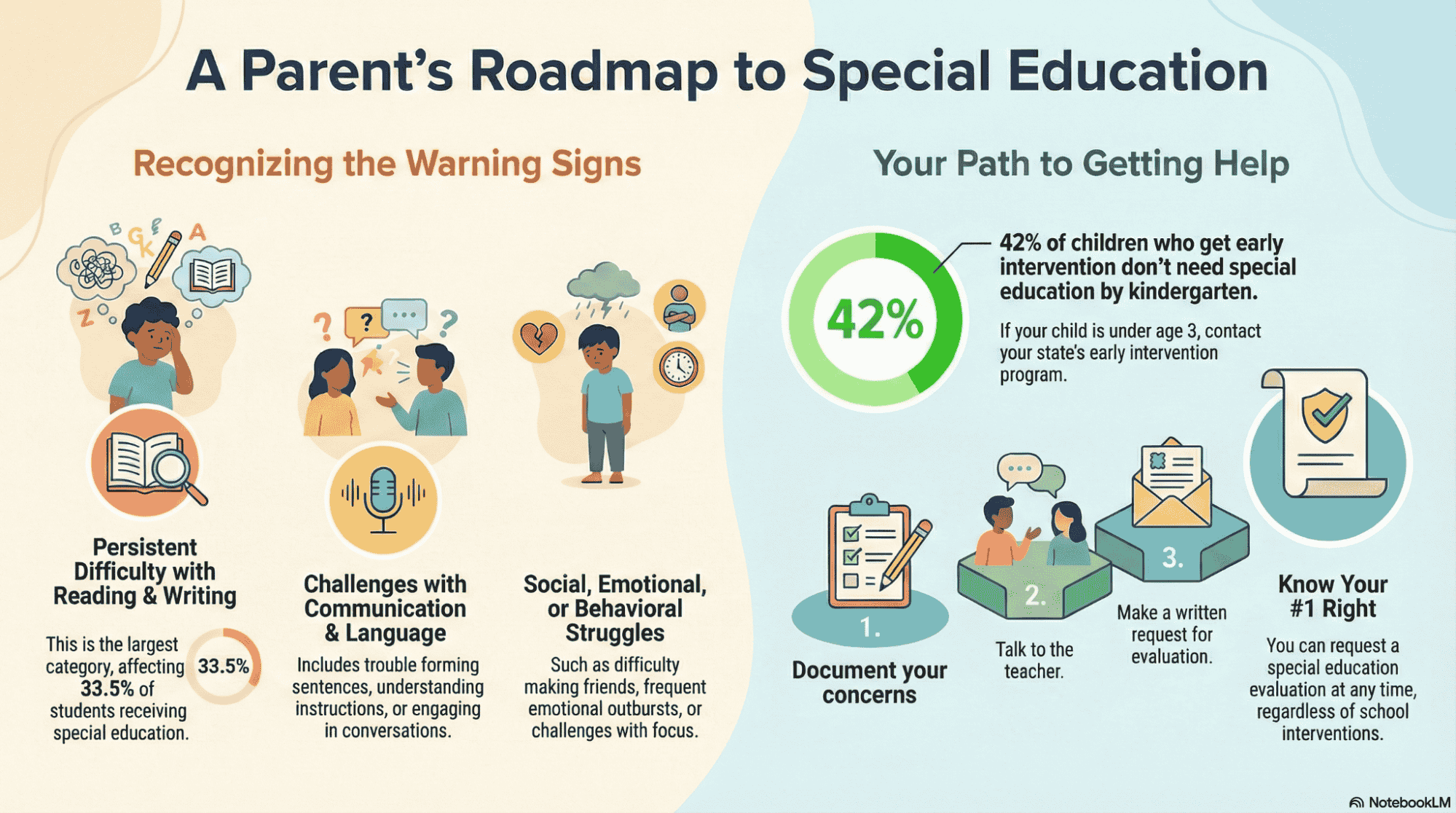
But here’s what you need to know: You have the right to request a special education evaluation at any time, regardless of what RTI tier your child is in. Schools cannot require you to wait.
Early Intervention: Why Age Matters

If your child is under age 3, early intervention services through Part C of IDEA can make a profound difference. Research shows that 42% of young children who receive early intervention don’t need special education by kindergarten.
The CDC recommends developmental screening at 9, 18, and 30 months, with autism-specific screening at 18 and 24 months. In 2022, the CDC updated developmental milestones to show what 75% of children can do by each age—making it clearer when missing a milestone requires immediate action rather than “wait and see.”
Contact your pediatrician or state early intervention program if your child:
- Doesn’t smile by 4 months
- Shows limited vocabulary by 2 years or difficulty with two-word phrases
- Doesn’t engage in back-and-forth conversation by age 3
- Has lost previously acquired skills at any age
Medicaid covers more than 40% of births and provides funding for Part C services, making early intervention accessible regardless of income.
7 Warning Signs Your Child May Need Special Education Services
1. Challenges with Communication and Language
Speech and language delays are among the most common reasons children receive special education services. Speech or language impairment accounts for a significant portion of students in special education.
You might notice:
- Difficulty pronouncing words or forming complete sentences
- Trouble understanding verbal instructions or following directions
- Limited vocabulary compared to peers their age
- Struggling to engage in back-and-forth conversations
- Frustration when trying to express needs or ideas
Language development looks different at different ages. By age 2, most children use two-word phrases. By age 3, they should engage in simple conversations. If your child isn’t meeting these milestones, early evaluation can help.
Speech and language therapy can address articulation problems, receptive language delays, expressive language challenges, and pragmatic language skills. An IEP can ensure your child receives this therapy during the school day.
2. Persistent Difficulty with Reading and Writing
Specific learning disabilities—reading, writing, and math—are the largest category of special education, representing 33.5% of students receiving services (2.4 million students).
Dyslexia affects approximately 10% of the population, with average diagnosis occurring at ages 7-8. However, early warning signs appear much earlier.
Preschool and early elementary indicators:
- Difficulty learning nursery rhymes
- Trouble with rhyming words or identifying letter sounds
- Difficulty recognizing letters or learning letter names
- Struggles with phonological awareness (breaking words into sounds)
- Family history of reading difficulties
Elementary and beyond:
- Difficulty learning to read, recognize words, or decode unfamiliar words
- Problems with handwriting, spelling, or organizing thoughts on paper
- Slow reading speed despite effort
- Challenges understanding written material
- Persistent frustration or avoidance of reading and writing tasks
Universal screening in kindergarten and first grade using standardized tools can identify at-risk students early. Students who receive intensive, systematic phonics instruction and multisensory interventions in early grades show significant improvement. The key is intervening before third grade, when reading shifts from “learning to read” to “reading to learn.”
If your child struggles with reading and writing despite good instruction, request an evaluation for a specific learning disability. An IEP can provide specialized reading instruction, assistive technology, extended time, and modified assignments.
3. Difficulty with Social Skills and Emotional Regulation
Social-emotional challenges can signal autism spectrum disorder, ADHD, emotional disability, or other conditions requiring specialized support.
Autism diagnosis rates have increased 175% over the past decade, with prevalence reaching 1 in 31 children aged 8 years in 2022. ADHD now affects 11.4% of U.S. children (7.1 million), up from 6-8% in 2000.
Warning signs include:
- Difficulty making and maintaining friendships
- Trouble reading social cues or understanding unspoken rules
- Frequent meltdowns, tantrums, or emotional outbursts that seem out of proportion
- Difficulty understanding or responding to emotions—their own and others’
- Problems with transitions or changes in routine
- Anxiety that interferes with daily functioning
- Aggressive behavior or difficulty controlling impulses
- Withdrawal from social situations
These struggles aren’t “just a phase” if they persist over time and interfere with your child’s ability to learn and participate in school.
An IEP can include social skills instruction, counseling services, behavior intervention plans, regular breaks for emotional regulation, and strategies for managing anxiety. Some students may receive support from a social worker, school psychologist, or behavioral specialist.
4. Challenges with Focus, Attention, and Executive Function
ADHD is one of the most common conditions affecting school-aged children, but attention difficulties can also stem from anxiety, learning disabilities, or other cognitive challenges.
Signs that may indicate a need for evaluation:
- Inability to stay seated or focus on tasks for age-appropriate periods
- Easily distracted by external stimuli or internal thoughts
- Difficulty following multi-step instructions
- Problems with organization, planning, and time management
- Forgetting materials, assignments, or instructions regularly
- Inconsistent performance despite effort
- Difficulty completing work within expected timeframes
- Impulsive behavior that disrupts learning
Not all children with ADHD qualify for an IEP—some receive accommodations through a 504 Plan instead. The difference? If your child can succeed in general education with accommodations (extended time, preferential seating, frequent breaks), a 504 Plan may be sufficient. If they need specialized instruction beyond accommodations, an IEP is appropriate.
An IEP for attention challenges might include direct instruction in executive function skills, modified assignments, organizational support, behavior management strategies, and assistive technology.
5. Struggles with Motor Skills
While young children can be clumsy as they develop coordination, persistent motor skill difficulties may signal developmental coordination disorder or other conditions requiring support.
Fine motor skill challenges:
- Difficulty holding a pencil with appropriate grasp
- Trouble with tasks like cutting with scissors, buttoning shirts, or tying shoes
- Messy or illegible handwriting despite effort
- Difficulty manipulating small objects
Gross motor skill challenges:
- Lack of coordination or frequent falls
- Problems with balance
- Difficulty with activities like catching a ball, skipping, or riding a bike
- Challenges controlling body movements
Occupational therapy and physical therapy can address these challenges. An IEP ensures your child receives these related services during the school day, along with accommodations like a slant board for writing, access to a computer for assignments, or modified physical education activities.
6. Academic Performance Consistently Below Grade Level
If your child works hard but still struggles to keep up with grade-level expectations, they may have an undiagnosed learning disability or other condition affecting academic performance.
Warning signs:
- Falling behind in one or more subjects, especially reading, writing, or math
- Consistently low test scores despite studying
- Difficulty retaining information or mastering new skills
- Slow progress even with extra help at home
- Growing gap between your child’s performance and their peers
- Frustration, anxiety, or declining confidence about school
Under IDEA, students in grades K-9 can qualify under the category of “developmental delay” if they demonstrate delays across multiple areas. Older students typically qualify under more specific categories like specific learning disability or intellectual disability.
A comprehensive evaluation examines cognitive abilities, academic achievement, processing skills, and other factors. Schools must use multiple assessment tools and gather information from various sources—not base eligibility on a single test.
If your child qualifies, their IEP will include measurable annual goals, specialized instruction to address skill gaps, accommodations, and modifications as needed.
7. School Refusal, Frequent Absences, or School Avoidance
School refusal differs from truancy—it involves emotional distress rather than defiance. This condition frequently co-occurs with anxiety disorders, depression, and physical symptoms like headaches or stomachaches.
Warning signs of school refusal:
- Physical complaints (headaches, stomachaches) that appear on school mornings and improve when staying home
- Panic symptoms, crying episodes, or temper tantrums before school
- Difficulty sleeping or nightmares related to school concerns
- Repeated requests to stay home or clinging behavior
- Missing 10% or more of school days
The longer avoidance continues, the harder it becomes to return. School refusal often stems from separation anxiety, social phobia, panic disorder, post-traumatic stress disorder, major depressive disorder, or adjustment disorder. Recent research also links it to cyberbullying, diminished self-concept, and undiagnosed learning disabilities.
If school refusal stems from anxiety that substantially impacts educational performance, undiagnosed learning disabilities causing overwhelming stress, social skills deficits related to autism, or mental health conditions affecting attendance, your child may qualify under emotional disability or other health impairment categories.
An IEP can include counseling services, behavior intervention plans, modified schedules or assignments to reduce anxiety, mental health services, and gradual reentry plans.
Noticing these signs? Trust your instincts.
Understanding Your Options: IEP vs. 504 Plan

Not all children who need support qualify for an IEP. Section 504 of the Rehabilitation Act provides another avenue for accommodations.
Key differences:
| Feature | IEP | 504 Plan |
| Legal basis | IDEA (special education law) | Section 504 (civil rights law) |
| Eligibility | One of 13 IDEA categories + adverse educational impact | Any disability affecting major life activities |
| Services | Specialized instruction, related services, accommodations | Accommodations only |
| Documentation | Formal document with annual goals | No standard format required |
| Evaluation | Comprehensive assessment required | Less formal evaluation process |
Example: A student with ADHD might receive a 504 Plan if they need extended time and preferential seating but can succeed within the general curriculum. The same student would qualify for an IEP if ADHD severely impacts learning and they need specialized instruction beyond accommodations.
The 13 IDEA Disability Categories
To qualify for special education, your child must have one of these disabilities:
- Autism
- Deaf-blindness
- Deafness or hearing impairment
- Emotional disability/disturbance
- Intellectual disability
- Multiple disabilities
- Orthopedic impairment
- Other health impairment (includes ADHD)
- Specific learning disability
- Speech or language impairment
- Traumatic brain injury
- Visual impairment
- Developmental delay (ages 3-9 only)
Remember: Having a diagnosis doesn’t automatically qualify a child for special education. The condition must impact their ability to learn in a general education classroom without specialized support.
The Evaluation Process: What to Expect
If you suspect your child needs special education services, here’s what happens next.
Timeline requirements:
- Schools must respond within a reasonable timeframe (often 10-15 days) after receiving your written referral
- Evaluation must be completed within 60 days of receiving parental consent (or state-established timelines)
- Eligibility meeting must occur within 30 days of evaluation completion
- If eligible, IEP must be developed and implemented without unnecessary delay
What the evaluation includes: The comprehensive assessment examines all areas of concern: academic performance, cognitive abilities, speech/language, motor skills, and social-emotional functioning. Evaluators use multiple assessment tools and gather information from teachers, parents, and observations.
Re-evaluation: Students must be re-evaluated every three years unless the IEP team and parents agree otherwise.
Your Rights Under IDEA
You have substantial rights in the special education process:
Participation rights:
- Participate in all meetings about identification, evaluation, placement, and services
- Receive prior written notice before any changes to services or placement
- Give or deny consent for evaluation and services
Information access:
- Review all educational records
- Obtain an independent educational evaluation (IEE) at district expense if you disagree with their evaluation
- Receive complete explanation of procedural safeguards
Dispute resolution options:
- Request mediation
- File a state compliance complaint alleging violations of IDEA
- Request a due process hearing before an impartial hearing officer
- Seek compensatory services or reimbursement
Parents can unilaterally place their child in private school and seek tuition reimbursement if they can prove the placement is appropriate under IDEA and they cooperated with the district.
Transition Planning for Older Students
IDEA requires transition planning to begin no later than age 16 (earlier in some states—age 14 in Ohio and New York). This applies to all students with IEPs, including those planning to attend college.
Transition planning includes:
- Age-appropriate transition assessments identifying strengths, interests, preferences, and needs
- Measurable postsecondary goals for education/training, employment, and independent living
- Coordinated activities and services to help achieve goals
- Annual updates to the transition plan
Students receiving special education services have the right to continue through age 21 (until they turn 22).
What to Do If You Notice Warning Signs
If you’re concerned about your child, take these steps:
- Document observations: Keep dated notes of specific behaviors, academic struggles, and frequency of concerns
- Talk to teachers: Request a meeting to discuss observations and review classroom performance
- Request screening: Ask about RTI/MTSS interventions already in place
- Submit written referral: If concerns persist, submit a written request for special education evaluation (email counts—get confirmation of receipt)
- Know timelines: Track deadlines for school response and evaluation completion
- Gather outside documentation: Include pediatrician assessments, therapy reports, or private evaluations
- Attend all meetings: Bring an advocate or support person if needed
- Don’t sign immediately: Take IEP documents home to review before signing if you need time
Where to Get Help

Resources available to you:
- State Parent Training and Information Centers (PTIs) – federally funded, free assistance to families
- CDC Milestone Tracker app – monitors developmental milestones from 2 months to 5 years
- Local early intervention programs (Part C services for ages 0-3)
- State departments of education – special education divisions
- Disability Rights organizations in your state – legal advocacy services
You Don’t Have to Navigate This Alone
As parents of children with disabilities, you’ve worked hard to make sure your child gets the support they deserve. You’ve probably spent countless hours researching, advocating, and worrying whether you’re doing enough.
Here’s what I want you to know: Recognizing these warning signs and taking action is one of the most important things you can do for your child’s future. Early identification and intervention can change everything.
Whether your child struggles with reading, attention, social skills, or any other area of development, they have rights under the law. You don’t need to become a legal expert to get your child what they need—that’s my job.
At Stone Educational Advocacy & Consulting, I guide families through every step of the special education process. From requesting evaluations to attending IEP meetings to ensuring your child receives appropriate services, I’m here to make sure your voice is heard and your child’s rights are protected.
If you’re uncertain about whether your child needs special education services, or if you’re frustrated with the support they’re currently receiving, reach out. Let’s work together to build an education plan that helps your child thrive.
Frequently Asked Questions
How do I know if my child needs special education or just extra help?
If your child struggles despite receiving good instruction and targeted interventions in the general education classroom, they may need special education. The key question is whether they require specially designed instruction—not just accommodations or extra tutoring—to make meaningful progress. Request an evaluation if concerns persist after trying interventions.
Can I request a special education evaluation even if the school says my child doesn't need one?
Yes. You have the right to request an evaluation at any time by submitting a written request to your school district. Schools must respond to your request and either agree to evaluate or provide a written explanation of refusal. If they refuse, you have dispute resolution options including mediation and due process.
What's the difference between an IEP and a 504 Plan, and which does my child need?
An IEP provides specialized instruction and services for students who qualify under one of 13 IDEA disability categories. A 504 Plan provides accommodations for students with disabilities who can succeed in general education with support. If your child needs modified curriculum or specialized teaching strategies, they likely need an IEP. If they need accommodations like extended time or preferential seating but can handle grade-level curriculum, a 504 Plan may be sufficient.
How long does the special education evaluation process take?
Schools must complete the evaluation within 60 days of receiving your written consent (some states have different timelines). After the evaluation, the eligibility meeting must occur within 30 days. If your child qualifies, the IEP must be developed and implemented without unnecessary delay. The entire process typically takes 2-3 months from initial referral to IEP implementation.
What happens if I disagree with the school's evaluation or proposed IEP?
You have several options: request an Independent Educational Evaluation (IEE) at district expense, request mediation to resolve disagreements, file a state compliance complaint, or request a due process hearing. You’re not required to sign an IEP you disagree with, and you can request changes before agreeing to implementation.
Does my child have to go to special education classes to receive services?
No. IDEA requires students to be educated in the Least Restrictive Environment (LRE), meaning with non-disabled peers to the maximum extent appropriate. Many students with IEPs spend most or all of their day in general education classrooms and receive support through accommodations, modifications, or pull-out services for specific subjects.
Can my child receive special education services for mental health conditions like anxiety or depression?
Yes. Students can qualify under the category of emotional disability or other health impairment if their mental health condition adversely affects educational performance. An IEP can include counseling services, behavior intervention plans, accommodations for anxiety, and other mental health supports. Schools must address mental health needs that impact learning.
What if my child has a diagnosis but the school says they don't qualify for special education?
A medical diagnosis alone doesn’t guarantee special education eligibility. To qualify, three criteria must be met: (1) the child has a qualifying disability, (2) it adversely affects educational performance, and (3) they need specially designed instruction. If your child is doing well academically despite their diagnosis, they may not qualify for an IEP but might be eligible for a 504 Plan instead.
How often will my child's IEP be reviewed and updated?
IEPs must be reviewed at least annually, though you can request a meeting at any time to discuss concerns or needed changes. Your child must be re-evaluated every three years to determine continued eligibility, though you or the school can request re-evaluation sooner if needed.
Will special education services follow my child to college?
IEPs end when students graduate high school or age out at 22. However, students with documented disabilities are entitled to reasonable accommodations in college under the Americans with Disabilities Act (ADA) and Section 504. The college’s disability services office provides support, but the process and services differ significantly from K-12 special education. Transition planning should prepare students for this shift.